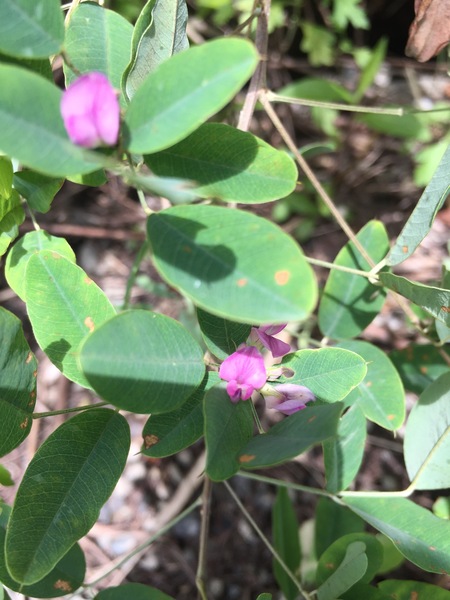
Japanese name: ツクシハギ(筑紫萩) Scientific name:Lespedeza homoloba
[Overview]
A deciduous subshrub or shrub up to 2 m tall, found on sunny slopes in hills to mountains.
The leaves are alternate and compound, made up of 3 leaflets, which are elliptic to ovate, 2–6 cm long, and somewhat thick.
The upper surface of the leaves is hairless except for the midrib, or hairless throughout, and the underside has appressed hairs.
The leaf margins are entire.
Racemes arise from the leaf axils and extend longer than the leaves.
The flowers are pale reddish purple and pea-shaped, with the outside of the standard petal and the keel petals a very pale color.
The pods do not split open even when ripe.
[Cultivation]
It prefers sun and is easy to grow, thriving even in poor or dry ground as long as the soil is not overly wet.
It is cold-hardy, but most of the aboveground part dies back in winter, so cut it back to ground level so that new branches grow the following year.
Transplanting is easy as long as it is done while the plant is leafless.