EVERGREEN

Plant Encyclopedia

Lespedeza bicolor var. bicolor

Lespedeza bicolor var. bicolor (shrubby bushclover, "Yamahagi")

Japanese name: ヤマハギ (山萩)
Scientific name: Lespedeza bicolor var. bicolor

Lespedeza bicolor var. bicolor

[Overview]
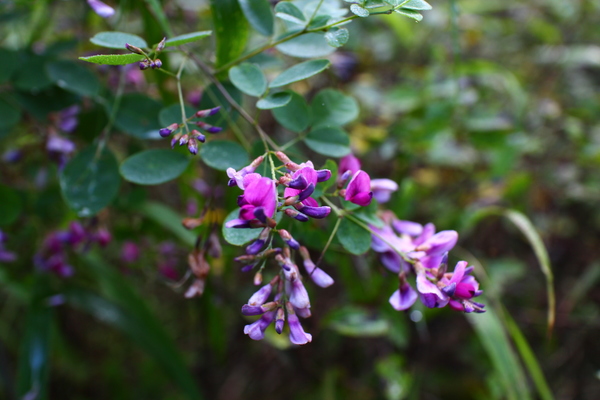
A deciduous subshrub reaching 2 m in height, commonly found in sunny mountain areas.
Leaves are alternate and trifoliate, and the leaflets are elliptic, 1.5–4 cm long.
The upper surface of the leaf has short hairs when young, and later becomes hairless or retains some hairs; the underside has short hairs.
The leaf margin is entire.
The stipules are small and lanceolate.
The flowers are pea-shaped and are borne spirally in pairs on compound racemes arising from the leaf axils.
The inflorescence extends longer than the leaves.
The flower color is reddish purple.
The legume does not split open even when ripe.

[Cultivation]
It likes sun and is easy to grow, thriving even in poor or dry soil as long as the soil is not too wet.
It is hardy against cold, but most of the above-ground part dies back in winter, so cut it back to ground level and let new branches grow the following year.
Transplanting is easy as long as it is done while the plant is leafless.

Details

Names
English: shrubby bushclover, shrub lespedeza, bicolor lespedeza
Japanese: ヤマハギ(山萩)、エゾヤマハギ(蝦夷山萩)
Life form
Shrub
Evergreen / deciduous
Deciduous
Leaf type
Broadleaf
Habit
Terrestrial
Planting (or sowing) season
November, December, January, February, March
Flowering season
July, August, September
Fruiting season
October, November
Distribution or origin
Japan (Hokkaido to Kyushu), Korea, northern and northeastern China, eastern Siberia, Ussuri, Amur, southern Kuril Islands
Growth form
Branching
Height
2000 mm
Leaf shape
Trifoliate compound leaf
Leaf arrangement
Alternate
Leaf margin
Entire
Inflorescence
Compound raceme
Flower color
Purple
Leaf color
Green
Availability of seeds and plants
Low
Form sold
Seedlings
Sun exposure
Full sun
Water needs
Moderate
Soil needs
Required
Suitable uses
Bonsai, Potted plant, Hedge, Flower bed, Parks and gardens, Slope greening
Diseases
Rust
Pests
Aphids
Japan Flower Trade Code
59866

Translated from our Japanese encyclopedia. If anything differs, the Japanese page is correct.

Sponsored