
Plant Encyclopedia

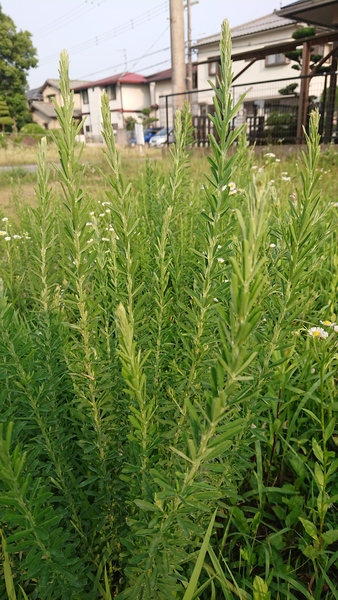
Lespedeza cuneata var. cuneata ("Medohagi")
Japanese name: メドハギ (蓍萩、目処萩)
Scientific name: Lespedeza cuneata var. cuneata
[Overview]
A perennial 1 m tall, found in sunny grasslands, riverbanks, embankments and similar places.
The stems are hard, become woody, stand upright and branch frequently.
The leaves are borne pointing upward along the stems.
The leaves are trifoliate, with the terminal leaflet slightly larger, narrowly obovate to linear, 0.7–2.5 cm long, with a rounded or slightly notched tip.
The flowers are borne in clusters of 2–4 in the leaf axils; they are pale yellowish white, with reddish purple spots on the standard petal.
Cleistogamous flowers are also produced.
The fruit is a nearly round loment, about 0.3 cm in diameter.
[Uses]
The whole plant is used as a folk medicine.
In Tsushima, the Amami region, the main island of Okinawa and elsewhere, there is a custom of placing chopsticks made from Medohagi stems beside the offering meal during Obon (the summer festival for ancestors).
[Notes]
The name is said to derive from "medogihagi," as the leafless stems were used in place of the divination sticks (zeichiku).
Details
Translated from our Japanese encyclopedia. If anything differs, the Japanese page is correct.