
Plant Encyclopedia

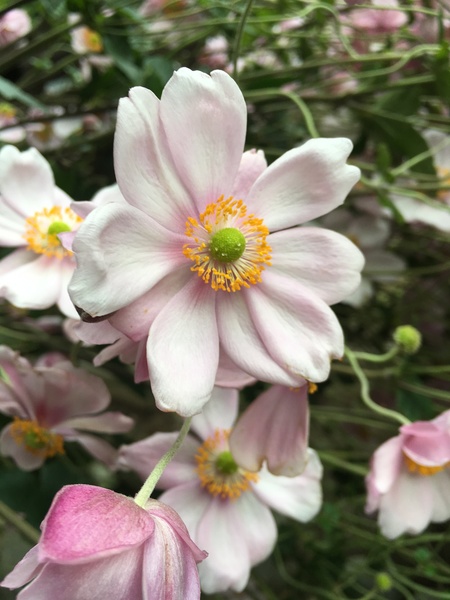
Anemone × hybrida ("Botankibunegiku")
Japanese name: ボタンキブネギク (牡丹貴船菊)
Scientific name: Anemone × hybrida
[Overview]
A perennial planted in gardens.
The stem grows 50–150 cm tall and is covered with appressed hairs.
A few basal leaves arise from the rhizome.
The basal leaves consist of 3 leaflets, each divided into 3–5 lobes.
The leaflets have toothed margins and leaflet stalks.
Leaves are whorled on the stem in groups of 2–3.
The lower stem leaves have short petioles and resemble the basal leaves, while the upper ones are small and almost stalkless.
The stem branches in the upper part and produces many long flower stalks, each bearing a single flower at its tip.
The flowers are white to pale pink, with 6–20 sepals that look like petals.
There are many stamens, and the anthers are yellow.
There are also many pistils, with slender stalks, gathered in a globe.
[Uses]
It is used as chabana (flowers for the tea ceremony).
[Cultivation]
Propagate usually by division or root cuttings.
It prefers sun to partial shade and fertile, well-drained, slightly moist soil.
In poor light it flowers poorly.
It dislikes heat and dryness, so keep direct sunlight off the base of the plant.
Move potted plants into shade in midsummer, and otherwise keep them in the sun.
It is very cold hardy, and once established in the garden it requires little care.
For plants in the garden, watering is not necessary unless the soil becomes extremely dry.
For potted plants, water when the soil surface dries so that they do not run dry.
Avoid fertilizing in hot weather; in spring and autumn, apply fertilizer placed on the soil once a month or liquid fertilizer once a week.
Pests and diseases include southern blight, powdery mildew, aphids, cutworms and pyralid moths.
Details
Translated from our Japanese encyclopedia. If anything differs, the Japanese page is correct.