
Plant Encyclopedia

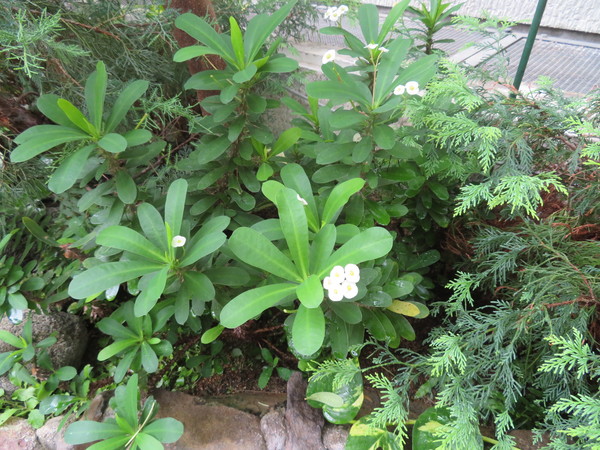
Euphorbia milii (crown of thorns, "Hanakirin")
Japanese name: ハナキリン
Scientific name: Euphorbia milii
[Overview]
An evergreen shrub reaching 1.8 m tall.
When the stems or leaves are damaged, a milky white latex comes out.
The stem is fleshy and erect, but when it becomes tall it creeps or leans on other things.
The stem is densely covered with thick spines about 3 cm long.
Leaves are simple and alternate, clustered at the stem tips in a whorl-like arrangement, elliptic, 3.5 cm long and 1.5 cm wide, though leaf size and shape vary.
It flowers all year round as long as the temperature allows.
The flowers are held in cyathia 1–2 cm across at the stem tips and have no perianth.
A pair of bracts enclosing the flowers are colored red, pink or similar, and stand out like petals.
Depending on the variety or cultivar, the bract color can also be orange, yellow, white and so on.
The fruit is a globose capsule.
[Cultivation]
Propagate by cuttings.
For cuttings, wash the milky white latex off the cut surface immediately with water or soak it in water, let the cut surface dry, and then insert the cutting.
The larger the cut surface, the harder it is to root.
It is weak against cold, so it is safest to keep it at 10°C or above for overwintering.
If water is withheld completely to make it dormant, it tolerates temperatures down to nearly 0°C.
It prefers sunny, well-drained soil.
If the conditions suit it, it is robust and grows well even if left alone.
In poor sunlight it may become leggy and the bract color may be poor.
For potted plants, from spring to autumn water thoroughly when the soil surface dries, and keep it on the dry side in winter.
For plants in the ground, rainfall is sufficient.
It tolerates dryness well.
From spring to autumn, apply slow-release fertilizer once every 2 months, or liquid fertilizer once a month.
Using a fertilizer high in phosphorus and potassium improves flowering.
Tall plants fall over, so cut them back in summer.
There are no particular pests or diseases.
Details
Japanese: ハナキリン
Translated from our Japanese encyclopedia. If anything differs, the Japanese page is correct.