
Plant Encyclopedia

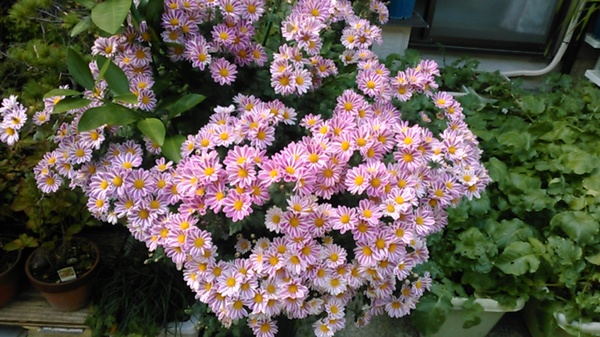
Chrysanthemum morifolium (spray mum)
Japanese name: スプレー菊
Scientific name: Chrysanthemum morifolium
[Overview]
A group of chrysanthemum cultivars; perennials.
Several lateral branches extend from the upper part of the stem.
The leaves are simple and alternate, and many are pinnately cut.
It is characterized by many flowers borne at the branch tips, each about 3–6 cm across.
There are many flower forms, including pompon, anemone, spider and clove types, and the flower colors are also abundant.
There is demand for it as flowers for Buddhist altars and the like.
[History]
It originated in America in the 1940s, then passed through Europe, and was first introduced to Japan in 1974 in Toyokawa, Aichi.
[Cultivation]
It prefers a sunny, well-drained, fertile site with slightly acidic to neutral soil.
Using fertilizer with a higher phosphate content helps it flower well.
Poor sunlight or insufficient fertilizer reduces flowering.
It dislikes dryness, so water thoroughly when the soil surface dries.
However, too much soil moisture causes root rot, so care is needed.
When day length falls to 13 hours or less, flower buds differentiate, and buds form in about half a month.
Therefore, when grown naturally, it flowers in autumn.
Propagate by cuttings or by dividing shoots.
Pests and diseases include powdery mildew, gray mold, aphids, cutworms and spider mites.
[Notes]
The name comes from the branches growing in a spray (spray) shape and bearing many flowers.
Details
Japanese: スプレー菊、スプレーマム
Translated from our Japanese encyclopedia. If anything differs, the Japanese page is correct.