
Plant Encyclopedia

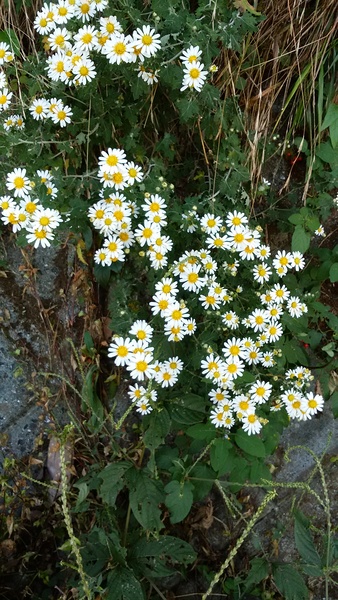
Chrysanthemum makinoi ("Ryunogiku")
Japanese name: リュウノウギク (竜脳菊)
Scientific name: Chrysanthemum makinoi
[Overview]
A perennial 40–80 cm tall, found on cliffs in sunny mountain areas.
It has a slender rhizome.
The stem branches.
Leaves are simple and alternate, ovate, about 4–8 cm long, 3-lobed, and grayish white on the underside.
There are short petioles.
A single flower head is borne at the end of each branch.
The flower heads are 2.5–5 cm across; the ray florets are white or pale pink, and the tubular florets are yellow.
The fruit is an achene.
[Uses]
The whole plant is used as a bath additive.
[Cultivation]
Propagate by stem cuttings or by dividing shoots.
It prefers a well-ventilated, sunny, well-drained place.
With poor sunlight, flowering is poor.
For potted plants, water thoroughly when the soil surface dries; for plants in the ground, rainfall is sufficient.
If basal fertilizer is applied, no further fertilizer is particularly necessary.
Pests and diseases include powdery mildew, gray mold, black spot, brown spot, Awadachiso-gunbai, Kikusui-kamikiri, aphids, cutworms, thrips and spider mites.
[Notes]
The stems and leaves have a scent similar to borneol.
Details
Translated from our Japanese encyclopedia. If anything differs, the Japanese page is correct.