
Plant Encyclopedia

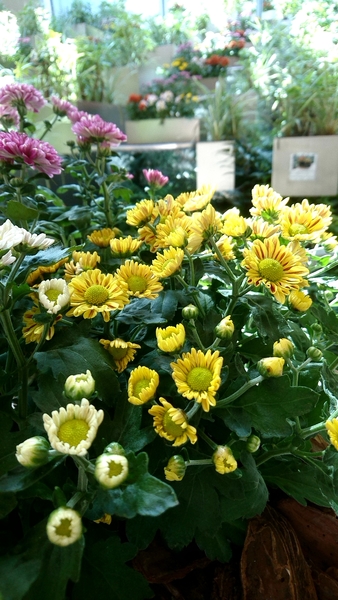
Chrysanthemum morifolium ("Pottomamu")
Japanese name: ポットマム
Scientific name: Chrysanthemum morifolium
[Overview]
A group of garden chrysanthemum cultivars; perennials.
A group with low plant height, suited to pot culture.
The leaves are simple and alternate, and many are pinnately lobed.
There are many flower forms, including pompon, anemone, spider and choji types, and the flower colors are also rich.
When day length falls to 13 hours or less, flower buds differentiate, and buds form in about half a month.
Therefore, when grown naturally, it blooms in autumn.
[History]
It originated in America in the 1950s.
[Cultivation]
Propagate from shoot cuttings or by dividing shoots.
It prefers a sunny, well-drained, fertile site with weakly acidic to neutral soil.
Poor sunlight or too little fertilizer reduces flowering.
Water thoroughly when the soil surface in the pot has dried.
If it runs short of water while in bloom, the flowers fall early.
Because the plant is low, take care when watering that mud does not splash onto it.
Moving it to a place sheltered from rain during the flowering period keeps the flowers from being damaged.
Apply slow-release fertilizer from spring to autumn, and giving extra phosphate when the buds are growing larger improves flowering.
In spring to early summer, cut back hard, leaving about 1/2–1/3 at the base, to increase the number of branches and flowers.
Pests and diseases include powdery mildew, gray mold, leaf blight, rust, black spot, brown spot, Awadachi-gunbai, Kikusui-kamikiri, aphids, cutworms, thrips and spider mites.
Details
Translated from our Japanese encyclopedia. If anything differs, the Japanese page is correct.