
Plant Encyclopedia

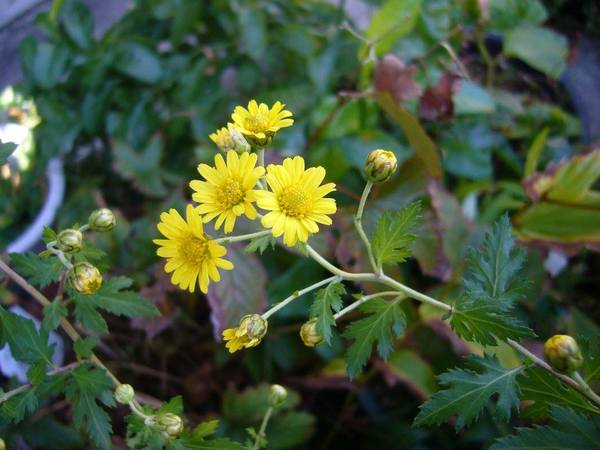
Chrysanthemum indicum var. indicum ("Shimakangiku")
Japanese name: シマカンギク (島寒菊)
Scientific name: Chrysanthemum indicum var. indicum
[Overview]
A perennial found in sunny places such as grassland and woodland edges near the coast.
The rhizome creeps sideways and forms large clumps.
The stem is 30–80 cm tall; the base lies down, and the upper part rises obliquely or stands erect and branches.
Young stems are blackish purple.
Leaves are simple and alternate, ovate-elliptic, about 3–5 cm long and 2.5–4 cm wide, pinnately divided into 5 lobes.
The leaves have petioles.
Corymb-like inflorescences at the stem tips bear many yellow flower heads.
The flowers are 2–2.5 cm across, with ray florets around the edge and tubular florets in the center.
The fruit is an achene.
[History]
It is considered one of the wild species that served as the basis for improving garden chrysanthemums.
[Uses]
The whole plant and the flower heads are used medicinally.
[Cultivation]
Propagate by stem cuttings or by dividing shoots.
It prefers a well-ventilated, sunny, well-drained place.
With poor sunlight, flowering is poor.
For potted plants, water thoroughly when the soil surface dries.
Plants in the garden need no particular watering.
It is relatively tolerant of dryness, but if it runs short of water the lower leaves wither.
However, excess soil moisture causes root rot, so for garden planting it is good to mound the soil about 10–30 cm.
Fertilizer is not particularly necessary, but applying a fertilizer rich in phosphate and potassium from spring to autumn improves flowering.
In May–June, cutting back hard, leaving about 1/2–1/3 at the base, increases the number of branches and flowers.
Pests and diseases include powdery mildew, gray mold, black spot, brown spot, Awadachiso-gunbai, Kikusui-kamikiri, aphids, cutworms, thrips and spider mites.
[Notes]
The alternative name Abura-giku comes from the use of the flowers, soaked in oil, as a remedy for wounds and the like.
Details
Translated from our Japanese encyclopedia. If anything differs, the Japanese page is correct.