
Plant Encyclopedia

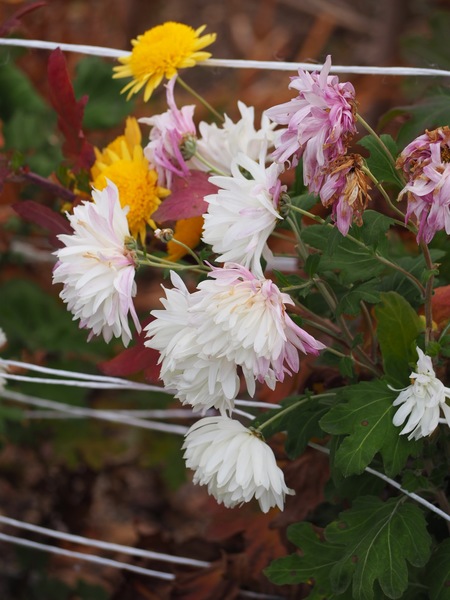
Chrysanthemum morifolium (florist's chrysanthemum, "Kiku")
Japanese name: キク (菊)
Scientific name: Chrysanthemum morifolium
[Overview]
A perennial of hybrid origin.
Many garden varieties have been created in Japan, and there are various lines with differing characteristics: large-flowered chrysanthemums (atsumono, atsubashiri, ichimonji, kudamono, Mino-giku), medium-flowered chrysanthemums (Edo-giku, Saga-giku, Ise-giku, Higo-giku, etc.), small-flowered chrysanthemums, and Western chrysanthemums.
Most are ornamental, grown in pots or as cut flowers, but there are also varieties whose flowers are eaten.
[History]
It is said to have originated in China from a cross between Chosen-giku and Haishima-kangiku.
It has long been revered in East Asia; it was already cultivated in the Zhou period, and in the Tang period beautiful varieties had already appeared and were celebrated in poetry.
In the Song period, several catalogue-like works called kikufu were published.
Because of its fragrance, beauty and elegance, and its noble bearing, it was revered together with ran (Fuji-bakama), plum (Ume) and bamboo (Take) as the "Four Gentlemen."
Under the influence of Chinese culture, its name appears in the Kaifuso, compiled in 751, in Japan, and from the Heian period onward it was highly valued not only in the arts but also in folk custom, as in chrysanthemum wine and the chrysanthemum-viewing gatherings of the Choyo festival.
Many varieties were created in the Edo period.
Because crossing is easy, today's chrysanthemums are thought to include several lines, such as Kohama-giku.
[Cultivation]
It prefers a sunny, well-drained, fertile place with weakly acidic to neutral soil.
More phosphate in the fertilizer improves flowering.
With poor sunlight or insufficient fertilizer, flowering is poor.
It dislikes dryness, so water thoroughly when the soil surface dries.
However, excess soil moisture causes root rot, so care is needed.
When day length falls to 13 hours or less, flower buds differentiate, and buds form in about half a month.
Therefore, when grown naturally, it flowers in autumn.
Propagate by stem cuttings or by dividing shoots.
Pests and diseases include powdery mildew, gray mold, aphids, cutworms and spider mites.
Details
Japanese: キク(菊)
Translated from our Japanese encyclopedia. If anything differs, the Japanese page is correct.