
Plant Encyclopedia

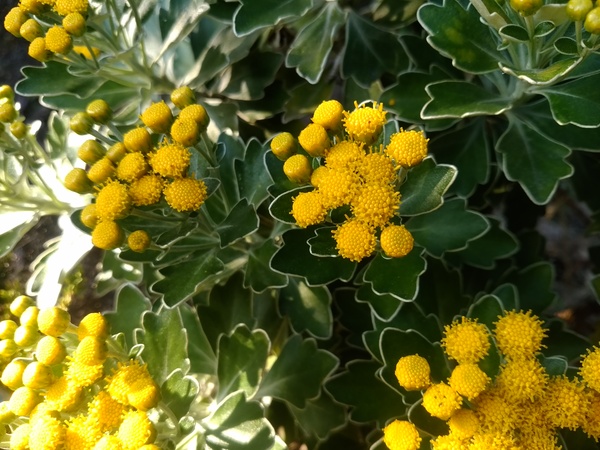
Chrysanthemum pacificum ("Isogiku")
Japanese name: イソギク (磯菊)
Scientific name: Chrysanthemum pacificum
[Overview]
A perennial 30–40 cm tall, found on coastal cliffs.
It extends its rhizome and forms large, clustered clumps.
The stem curves at the lower part and rises obliquely in the upper part.
Leaves are simple, densely alternate, oblanceolate to obovate, 4–8 cm long and 1.5–2.5 cm wide, and thick.
The leaf margin is entire, or shallowly pinnately lobed in the upper part.
The leaf surface has a few white hairs and is whitish green, while the underside is silvery white because of dense white hairs.
Gland dots on the leaf margin make it look edged in white.
Dense corymb-like inflorescences at the top of the stem bear many yellow flower heads.
The flower heads consist of tubular florets only.
[Cultivation]
Propagate by stem cuttings or by dividing shoots.
It prefers a well-ventilated, sunny, well-drained place.
With poor sunlight, flowering is poor.
Poor ventilation also makes the plant stuffy, causing disease and withering of the lower leaves.
For potted plants, water thoroughly when the soil surface dries.
Plants in the garden need no particular watering.
It is relatively tolerant of dryness, but if it runs short of water the lower leaves wither.
However, excess soil moisture causes root rot, so for garden planting it is good to mound the soil about 10–30 cm.
Fertilizer is not particularly necessary, but applying a fertilizer rich in phosphate and potassium from spring to autumn improves flowering.
Pinching in May–August produces side shoots and increases the number of branches, giving the plant fullness.
Flower buds form in summer, so pinching after that means no flowers will be seen that year.
After flowering, cut back hard to half the height.
There are no particular pests or diseases.
Details
Translated from our Japanese encyclopedia. If anything differs, the Japanese page is correct.