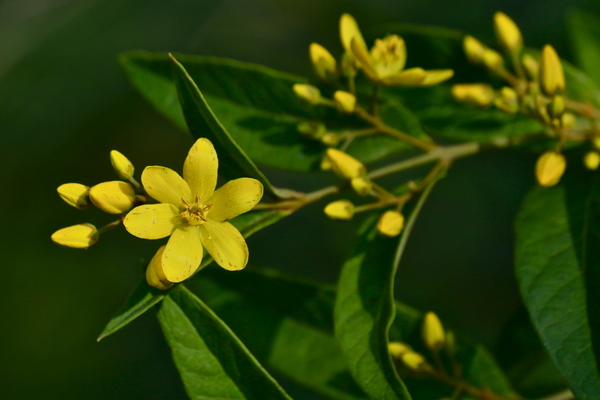
Japanese name: クサレダマ(草連玉) Scientific name:Lysimachia vulgaris subsp. davurica
[Overview]
A perennial 40–100 cm tall, found in wetlands in the mountains.
The underground stems creep.
The stem is fairly densely covered with glandular hairs.
Leaves are simple, opposite or in whorls of 4, lanceolate to oblong, 4–12 cm long and 1–4 cm wide, with a pointed tip.
The leaves have black glandular dots.
A panicle at the top of the stem bears many flowers.
The flowers are yellow, 1.2–1.5 cm across; the corolla is 5-lobed and the lobes are triangular-ovate.
The fruit is a spherical capsule.
[Uses]
The whole plant is used medicinally.
[Cultivation]
Propagate from seed or by division.
It is not particular about soil as long as the site is well drained and in sun to partial shade.
With poor sunlight, it flowers poorly.
If the conditions suit it, it grows well even when left alone.
Take care that it does not dry out in summer; for potted plants, water thoroughly when the soil surface dries, and for plants in the ground, also water in summer in the cooler morning or evening.
In addition to base fertilizer, apply slow-release fertilizer placed on the soil in spring, or give diluted liquid fertilizer.
There are no particular pests or diseases.
[Notes]
The Japanese name means a plant whose flowers resemble those of the redama, a member of the legume family.