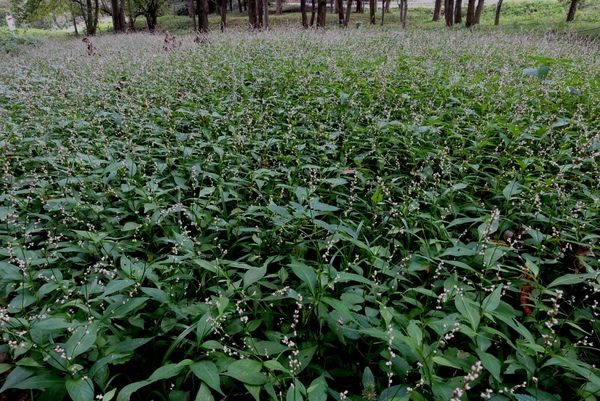
Japanese name: ハナタデ(花蓼) Scientific name:Persicaria posumbu var. posumbu
[Overview]
An annual 20–70 cm tall, found at woodland edges and in moist woods.
The stem branches; its lower part creeps along the ground or rises, and the upper part is erect.
Leaves are simple and alternate, ovate, 2–11 cm long and 1–4 cm wide, with a tail-like pointed tip.
Both sides of the leaf are sparsely hairy, and the upper surface usually has a blackish mark shaped like the kanji 八.
The stipule sheath is tubular, with coarse hairs on the veins, and the marginal hairs are almost as long as the sheath.
Pseudoracemes arise at the stem tips and from the leaf axils, bearing sparse flowers.
The flowers have no corolla, and the red to white calyx is conspicuous.
The fruit is a 3-angled achene, glossy black.
Leaf width and the length and density of the inflorescence vary.