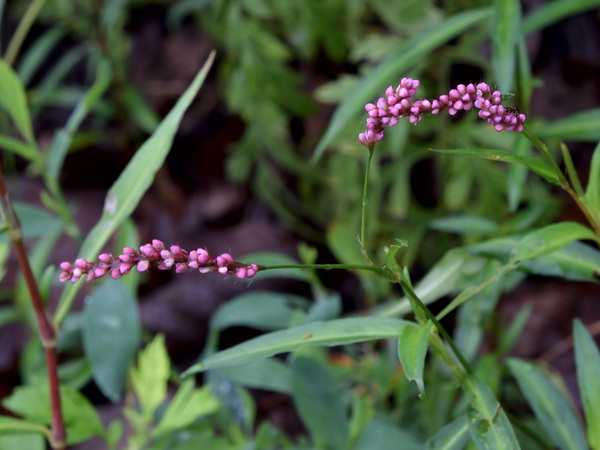
Japanese name: イヌタデ(犬蓼) Scientific name:Persicaria longiseta
[Overview]
An annual 20–60 cm tall, seen along roadsides and similar places.
The stem branches in the lower part and creeps along the ground, then stands erect in the upper part.
Leaves are simple and alternate, oblong-lanceolate, 3–13 cm long and 0.8–3 cm wide.
Hairs grow on the veins on the underside of the leaves and on the margins.
The ocrea is tubular, with coarse hairs on the outside, and numerous marginal hairs about as long as the ocrea itself.
Pseudoracemes 1–4.5 cm long at the stem tips bear flowers densely.
The flowers have no corolla; the conspicuous calyx is red (rarely white).
The fruit is a 3-angled achene, glossy black.
[Uses]
The stems and leaves are used as a folk remedy.