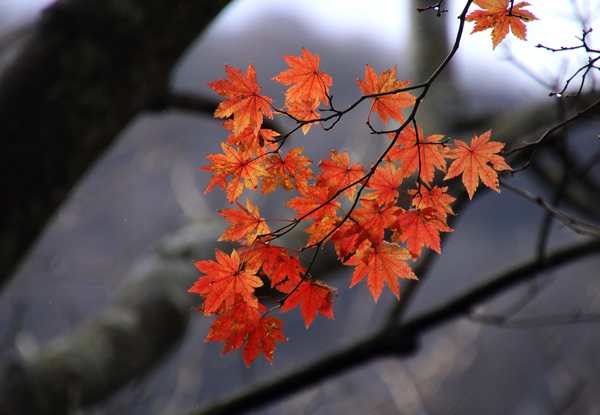
Japanese name: コハウチワカエデ(小葉団扇楓) Scientific name:Acer sieboldianum
[Overview]
A deciduous small tree or tree up to 15 m tall, growing in forests in low mountains.
The current-year twigs, inflorescences and young leaves are hairy.
Leaves are opposite, 4–7.5 cm long and 5–10 cm wide, palmately divided into 9 lobes, with a serrate or doubly serrate margin.
The petiole is 3–7 cm long, as long as the leaf or about 2/3 as long.
The leaves turn red or yellow in autumn.
The flowers are borne 15–20 in compound corymbs at the branch tips, with male flowers and bisexual flowers blooming on the same tree.
The flowers have 5 sepals and 5 petals.
The petals are pale yellow, and the sepals are pale yellow, sometimes tinged with purple.
The fruits are about 2 cm long and borne in pairs, each with a propeller-like wing, spreading almost horizontally.
[Cultivation]
Propagate from seed or cuttings.
It prefers a well-drained place in partial shade to full sun.
Partial shade is better, especially while the tree is young.
In shade, the autumn color develops poorly.
Longhorn beetles and aphids cause damage, so kill them as soon as they are found.