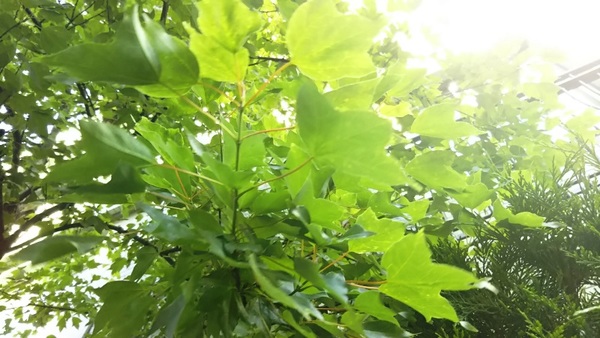
Japanese name: トウカエデ(唐楓) Scientific name:Acer buergerianum
[Overview]
A deciduous tree about 15 m tall.
The trunk is erect.
The leaves are opposite, 3–8 cm long and 2–5 cm wide, shallowly palmately divided into 3 lobes.
The leaf margins are entire, but young trees have teeth.
The leaf stalk is 2–6 cm long.
The leaves turn red in autumn.
There are male and female flowers, both borne about 20 in compound racemes 2–3 cm long.
The flowers are pale green, with 5 sepals and 5 petals.
The fruits are 2 cm long and borne in pairs, each with a propeller-like wing, and the wings spread from parallel to an acute angle.
[History]
It is said to have been introduced to Japan in the Edo period (Kyoho 6, 1721).
[Cultivation]
Propagate from seed or by cuttings.
It prefers a sunny, well-drained site.
Partial shade is better while the tree is young.
In shade the autumn color develops poorly.
Pests and diseases include powdery mildew, longhorn beetles and aphids.