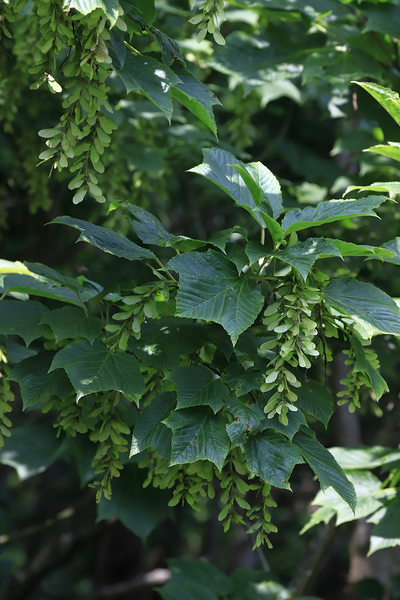
Japanese name: ウリハダカエデ(瓜膚楓) Scientific name:Acer rufinerve
[Overview]
A deciduous small tree or tree about 12 m tall, found in forests in low mountains.
The trunk is erect.
The bark is green with black patches.
Leaves are opposite, 6–15 cm both long and wide, shallowly palmately 3–5-lobed.
The leaf tip is drawn out into a tail.
The leaf margin has irregular double serration.
The petiole is 2–6 cm long.
The leaves and petioles are at first covered with reddish-brown hairs, but later become hairless except on the veins and in the vein axils on the underside of the leaf.
The leaves turn red in autumn.
The plant is dioecious or monoecious.
The flowers hang down, 10–20 in racemes 5–10 cm long at the branch tips.
The flowers are pale yellow, with 5 sepals and 5 petals.
The fruits are 2–3 cm long and borne in pairs, each with a propeller-like wing, spreading at an obtuse angle.
[Cultivation]
Propagate from seed or cuttings.
It prefers a well-drained place in partial shade to full sun.
Partial shade is better, especially while the tree is young.
In shade, the autumn color develops poorly.
Longhorn beetles and aphids cause damage, so kill them as soon as they are found.
[Notes]
The Japanese name compares the pattern of the bark to the skin of a melon.