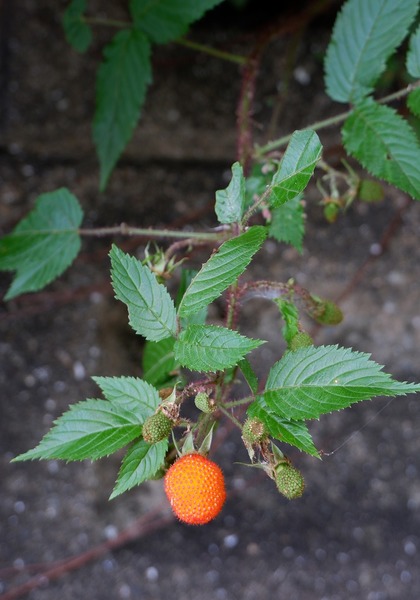
Japanese name: コジキイチゴ(乞食苺) Scientific name:Rubus sumatranus
[Overview]
A deciduous shrub 1–2 m tall, found at forest edges and in sunny places.
The stems, branches and leaf axes are densely covered with glandular hairs and sparsely with hooked prickles.
Leaves are alternate and odd-pinnately compound, consisting of 5–7 leaflets, but there are 3 leaflets on flowering branches.
The leaflets are narrowly ovate to broadly lanceolate, with irregular double teeth along the margin.
Both sides of the leaf are covered with hairs.
There are prickles on the veins of the underside of the leaf and on the leaf stalk.
Corymbs at the branch tips bear white 5-petaled flowers 1 cm across.
The outside of the flower stalk and calyx is densely covered with glandular hairs.
The fruit is a cylindrical to obovate aggregate fruit 1.5 cm long, ripening orange; it is edible.