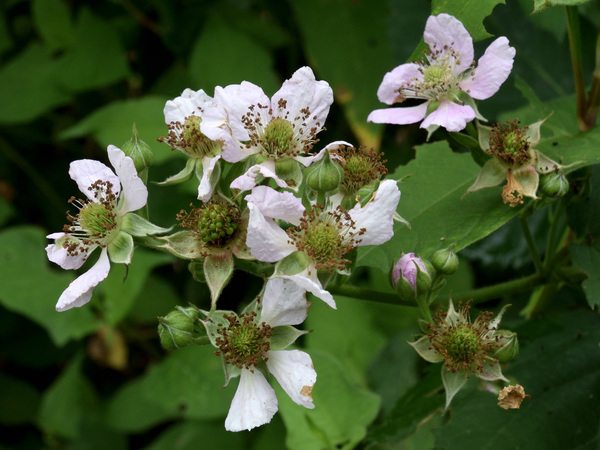
Japanese name: セイヨウヤブイチゴ(西洋薮苺) Scientific name:Rubus armeniacus
[Overview]
A small deciduous shrub.
The stems have stout hooked thorns and ridges, and lean on other plants in an arching manner.
Young stems have yellowish-brown hairs.
The leaves are alternate, either trifoliate or palmately compound with 5 leaflets, and the undersides are densely covered with white cottony hairs.
The terminal leaflet is ovate, 4–9 cm long, with serrations on the margin.
A panicle at the branch tips bears several white to pale pink five-petaled flowers about 2 cm across.
The fruit is an aggregate fruit that ripens from red to black.
[Cultivation]
Propagate by cuttings or layering.
It prefers a sunny, well-drained, fertile soil with good water retention.
Rainfall is sufficient unless sunny weather continues in summer and the soil dries out.
Apply organic fertilizer in winter, and apply fast-acting chemical fertilizer after flowering and in autumn.
After fruiting, cut the shoots that bore fruit that year at the base, leaving the newly grown shoots that will bear fruit next year.
Pests and diseases include scale insects and spider mites.