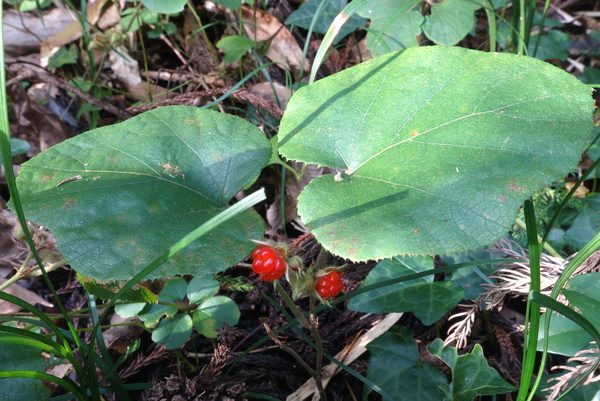
Japanese name: フユイチゴ(冬苺) Scientific name:Rubus buergeri
[Overview]
An evergreen shrub found at forest edges and inside forests at low elevations.
The stems extend like vines, creep along the ground, and are densely covered with soft hairs.
Slightly flattened thorns may also appear on the stems.
The leaves are round, 5–10 cm in both length and width, often shallowly 3–5-lobed, with fine serrations on the margin.
The tips of the serrations are awn-like.
Short soft hairs grow on the veins of the upper leaf surface, and spreading hairs grow densely on the underside.
The petioles are densely covered with soft hairs.
The stipules are pinnately divided.
Panicles from the leaf axils bear several white five-petaled flowers 1–1.3 cm across.
The calyx has long hairs on the outside and margin, and soft hairs on the inside.
The flower stalks also have short soft hairs.
The fruit is a spherical aggregate fruit that ripens red and is edible.
[Uses]
The fruit is edible.
[Cultivation]
Propagate by cuttings.
It prefers sun to partial shade and a fertile, well-drained soil with good water retention.
A site not exposed to cold winter winds is suitable.
Cultivation is easy.
Rainfall is sufficient.
Applying organic fertilizer in winter stabilizes fruit set.
There are no particular pests or diseases.
[Notes]
The Japanese name comes from the fact that it bears fruit in winter.