
Plant Encyclopedia

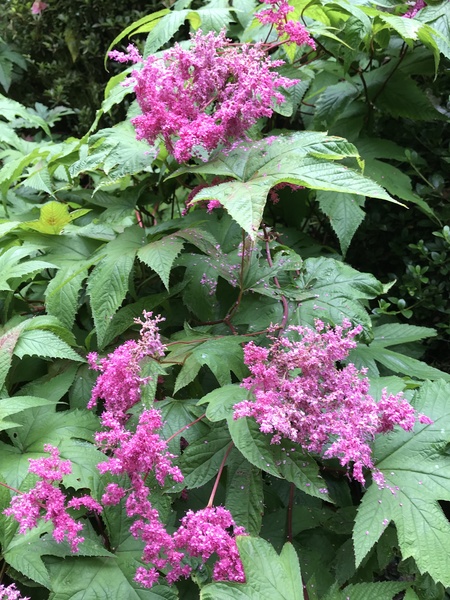
Filipendula purpurea ("Kyoganoko")
Japanese name: キョウガノコ (京鹿子)
Scientific name: Filipendula purpurea
[Overview]
A perennial 30–80 cm tall.
The stem is ridged and erect.
The leaves are of two kinds: basal leaves and leaves arranged alternately on the stem.
The leaves are odd-pinnately compound; the terminal leaflet is ovate, 7–20 cm long and 6–25 cm wide, palmately divided into 5–7 lobes, with doubly serrate or incised-serrate margins.
The lateral leaflets are small, ovate, up to 3.5 cm long and 2.5 cm wide, with coarsely toothed or entire margins.
Sometimes there are no lateral leaflets.
The stipules are small and inconspicuous, and clasp the stem.
Corymbs at the stem tips bear many pale pink flowers 4–5 mm across, with 4–5 petals.
The 20–25 long stamens stand out.
It usually does not set fruit.
[History]
A species of hybrid origin whose parents are unknown, cultivated since long ago.
[Cultivation]
Propagate by division.
It prefers partial shade and fertile, well-drained, moisture-retentive, moderately moist soil.
Avoid places that receive strong afternoon sun or that become dry.
For potted plants, water thoroughly when the soil surface dries; for plants in the ground, rainfall is sufficient unless summer brings a long spell of sunny weather and the soil becomes dry.
If fertilizer is applied at planting, no further fertilizer is particularly needed, but for potted plants diluted liquid fertilizer may be given once a month during the growing season.
There are no particular pests or diseases.
Details
Translated from our Japanese encyclopedia. If anything differs, the Japanese page is correct.