
Plant Encyclopedia

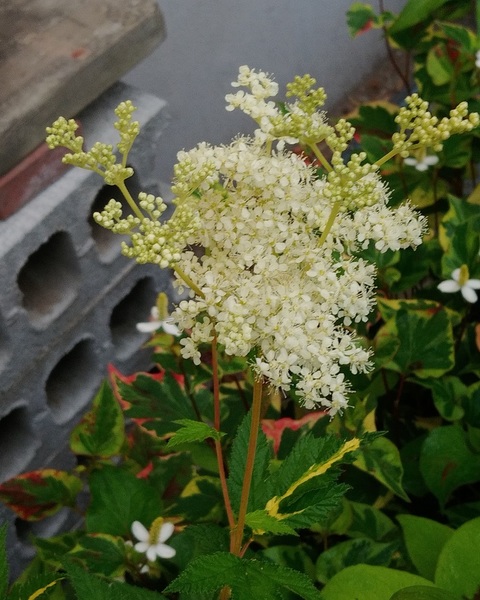
Filipendula ulmaria (meadowsweet, "Seiyonatsuyukiso")
Japanese name: セイヨウナツユキソウ (西洋夏雪草)
Scientific name: Filipendula ulmaria
[Overview]
A perennial 0.9–1.2 m tall, sometimes reaching 1.8 m, growing in its native range in damp lowland grasslands, marshes and along stream banks.
The stem is ridged, erect, and often reddish.
There are basal leaves and leaves arranged alternately on the stem.
The leaves are odd-pinnately compound with 7–9 leaflets; the terminal leaflet is 4–8 cm long, palmately divided into 3–5 lobes, and has toothed margins.
The undersides of the leaves are densely covered with white woolly hairs.
Cymes 10–15 cm long at the stem tips bear many small white 5-petaled flowers.
The 7–20 long stamens are conspicuous.
The flowers have a sweet fragrance.
[Uses]
It has long been used medicinally, and salicylic acid, first isolated in 1838, was later synthesized as aspirin.
In medieval England it was used as a strewing herb, scattered on floors to kill insects and disinfect.
The roots yield a reddish brown to black dye.
It is also used to flavor wine, beer, mead (honey wine) and jam, and in herbal tea.
The dried flowers are used in potpourri.
[Cultivation]
Propagate from seed or by division.
It prefers fertile, well-drained, moisture-retentive, moderately moist soil in sun to partial shade.
It dislikes acidic soil.
Avoid places with strong afternoon sun or dry conditions.
In regions with hot summers, it is best grown in partial shade.
Take care not to let it run short of water; for potted plants, water thoroughly when the soil surface dries, and for plants in the ground, rainfall is sufficient unless summer brings a long sunny spell and the soil dries out.
If fertilizer is applied at planting, no more is particularly needed, but for potted plants diluted liquid fertilizer may be given once a month during the growing season.
There are no particular pests or diseases, but spider mites and powdery mildew may appear when conditions are dry.
Details
Japanese: セイヨウナツユキソウ(西洋夏雪草)、メドウスイート
Translated from our Japanese encyclopedia. If anything differs, the Japanese page is correct.