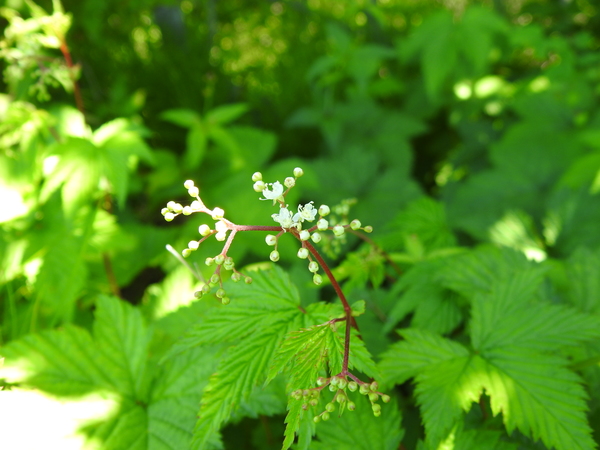
Japanese name: シコクシモツケソウ(四国下野草) Scientific name:Filipendula tsuguwoi
[Overview]
A perennial 30–70 cm tall, found on mountain ridges made of limestone or serpentine.
The stem is erect and ridged.
The leaves are of two kinds: basal leaves and stem leaves.
The stem leaves are alternate and odd-pinnately compound; there are 3–5 pairs of lateral leaflets, which are ovate, about 2 cm long and 1.5 cm wide.
The terminal leaflet is round, 6–13 cm across, palmately divided into 5–7 lobes, with a deeply heart-shaped base.
The upper surface of the leaf often bears short bristly hairs, and the veins on the underside bear curly yellowish-brown hairs.
The leaf margins are doubly serrate or incised-serrate.
The petiole is hairless, and the stipules are herbaceous.
It is dioecious.
Corymbs at the stem tips bear many white 5-petaled flowers about 4 mm across.
The many long stamens stand out.
The flower stalks and inflorescence axis usually bear curly yellowish-brown hairs.
The fruit is an ovate achene, slightly twisted.