
Plant Encyclopedia

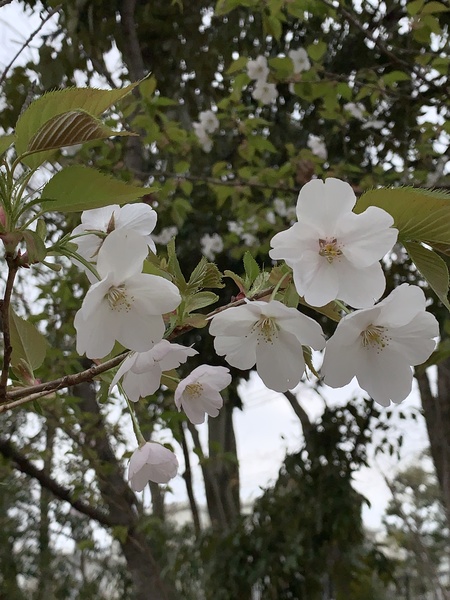
Cerasus speciosa ("Oshimazakura")
Japanese name: オオシマザクラ (大島桜)
Scientific name: Cerasus speciosa
[Overview]
A deciduous tree 15 m tall, with a trunk 1 m in diameter, sometimes 2 m.
The bark is purplish black to grayish purple, with conspicuous long horizontal brown lenticels.
The branches spread horizontally, giving an umbrella-shaped crown.
The first-year branches are hairless.
The young leaves are green and not reddish.
The leaves are obovate to obovate-elliptic, 9–12 cm long and 6.5–8 cm wide, with a tail-like pointed tip and a rounded base.
Both surfaces of the leaf are glossy and hairless.
The petiole is 1.5–3 cm long and hairless, with 2 nectar glands on the upper part.
The leaf margin has serrations whose tips extend long like awns.
The flowers open at the same time as the leaves unfold.
The flowers are borne 3–4 in corymbs from the leaf axils; they are white with 5 petals, large at 4.2–5.5 cm across.
The flowers are fragrant.
The petals are broadly elliptic, 17–19 mm long.
The calyx tube is cylindrical, 7–8 mm long.
The calyx lobes vary from having serrations on the margin to having none.
The flower stalk is 1.5–2.5 cm long, and the pedicels are 2–4 cm long.
The fruit is spherical, 11–13 mm across, and ripens blackish purple; it is bitter, but some become sweet and sour.
[Uses]
The leaves contain coumarin glycosides and have a distinctive fragrance, and the leaves, salted, are used for sakuramochi (cherry blossom rice cake).
The wood is used for building material, furniture and the like.
[Cultivation]
Propagate from seed, by cuttings, or by grafting.
It prefers a sunny, well-drained location.
If a garden-planted tree growing large would be a problem, it is good to limit the space for the roots with a fabric pot in order to control the size of the tree.
While it is still a young tree, protect it from frost by spreading straw around the base, for example.
Also, it is better not to cut branches needlessly if it is not necessary.
Care is needed because pests and diseases are numerous.
[Notes]
The Japanese name comes from its abundance on Izu-Oshima.
Trees planted for firewood and charcoal on the Boso Peninsula, Miura Peninsula, Izu Peninsula and elsewhere have become wild. Some consider those on the Izu Peninsula to be native.
Details
Translated from our Japanese encyclopedia. If anything differs, the Japanese page is correct.