
Plant Encyclopedia

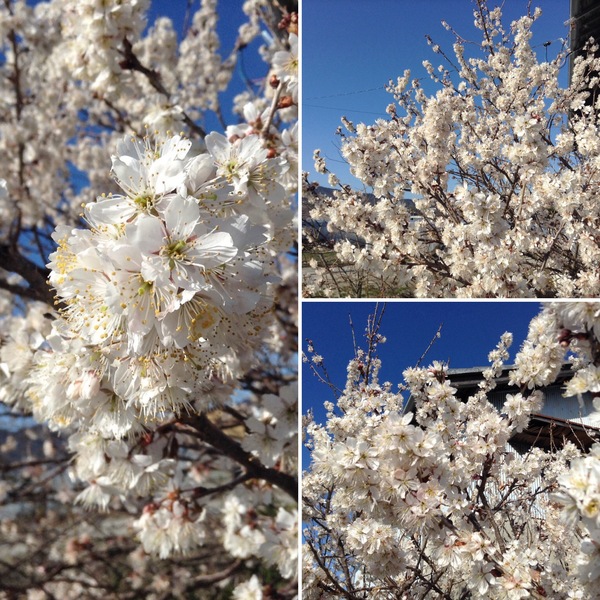
Cerasus avium (bird cherry, "Sakuranbo")
Japanese name: サクランボ (桜坊)
Scientific name: Cerasus avium
[Overview]
A deciduous tree grown as a fruit tree, reaching about 20 m in height.
The crown is pyramidal.
The leaves are obovate-oblong, 6–12 cm long, and tend to hang down, with pointed tips and broadly wedge-shaped bases.
The leaf margins have irregular serrations.
The undersides of the leaves have appressed hairs along the veins.
Two nectar glands are found on the upper part of the leaf stalk or at the base of the leaf blade.
The flowers open at the same time as the leaves unfold.
The flowers are borne 2–6 together in umbels from the leaf axils and are white with 5 petals.
The petals are obovate, 11–13 mm long.
The calyx tube is 5 mm long, and the calyx lobes are oblong, 5 mm long, and curve backward.
The fruit is 15–25 mm in diameter, ripening bright red to dark red, and the flesh is sweet.
The main production area in Japan is Yamagata, and cultivars such as 'Napoleon' and 'Sato-nishiki' are famous.
[History]
It has been eaten since prehistoric times and was already cultivated in Greece around 300 BC.
It was introduced to Japan in the early Meiji era.
[Cultivation]
Propagate from seed, by cuttings, or by grafting.
It prefers a sunny, well-drained place.
If it becomes a problem by growing into a large tree in a garden, it is good to restrict the space for root growth with a fabric pot to control the size of the tree.
While the tree is young, protect it from frost by spreading straw around the base, for example.
Also, it is better not to cut branches needlessly.
Because pests and diseases are numerous, care is needed.
To protect the fruit from wild birds, cover the tree with netting or the like.
Fruit may split if it is rained on during the harvest season, so protection from rain is necessary.
[Notes]
The anniversary of Dazai Osamu's death (June 13) is called "Ota-ki" (Cherry Memorial Day).
Details
Japanese: サクランボ(桜坊)、オウトウ(桜桃)、セイヨウミザクラ(西洋実桜)、カンカオウトウ(甘果桜桃)、サクランボウ(桜坊)
Translated from our Japanese encyclopedia. If anything differs, the Japanese page is correct.