
Plant Encyclopedia

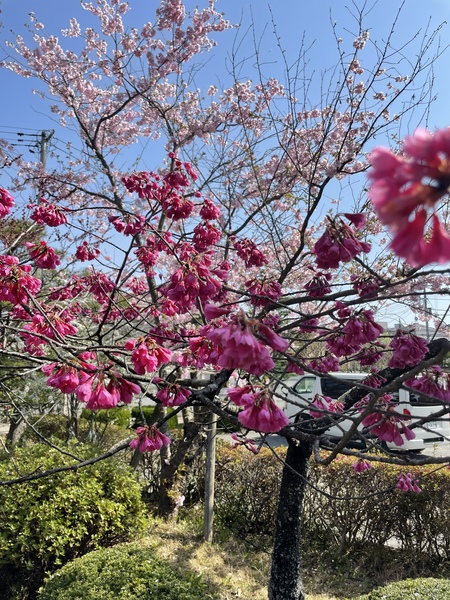
Cerasus campanulata (Taiwan cherry, "Kanhizakura")
Japanese name: カンヒザクラ (寒緋桜)
Scientific name: Cerasus campanulata
[Overview]
A deciduous small tree about 8 m tall.
The bark is dark purplish brown, irregularly and shallowly split crosswise, with lenticels arranged side by side.
First-year branches are hairless.
The leaves are elliptic to oblong-elliptic, 8–13 cm long and 2–5 cm wide, with a tail-like pointed tip and a rounded to obtuse base.
The leaf margin has shallow, fine serrations.
The leaves are hairless on both surfaces.
The petiole is about 1 cm long and hairless.
Two nectaries are borne on the upper part of the petiole.
It flowers before the leaves unfold.
The flowers hang downward, 2–3 in a corymb arising from the leaf axils; they are usually scarlet-red and 5-petaled, half-open in a bell shape.
The flower color varies from white to red.
The petals are broadly elliptic, about 1 cm long.
The style is hairless.
The calyx tube is bell-shaped-tubular and the calyx lobes are elliptic to oblong-elliptic with entire margins; both are reddish purple.
The flower stalk is about 3 mm long and the pedicels are 1–2 cm long; both are hairless.
The fruit is ovate-round, 12–16 mm long and about 3 cm across, and ripens red.
[Cultivation]
Propagate from seed, by cuttings, or by grafting.
It prefers a sunny, well-drained site.
If it becomes troublesome by growing into a large tree in a garden, limit the space available to the roots with a fabric pot to control the size of the tree.
While it is still a young tree, protect it from frost by spreading straw around the base, for example.
Also, it is better not to cut branches needlessly if there is no need.
It is prone to many pests and diseases, so care is needed.
[Notes]
Those considered to be native on Ishigakijima are thought to have become naturalized.
Details
Japanese: カンヒザクラ(寒緋桜)、ヒカンザクラ(緋寒桜)、サツマザクラ(薩摩桜)、ヒザクラ(緋桜)、ガンジツザクラ(元日桜)、サツマヒザクラ(薩摩緋桜)
Translated from our Japanese encyclopedia. If anything differs, the Japanese page is correct.