
Plant Encyclopedia

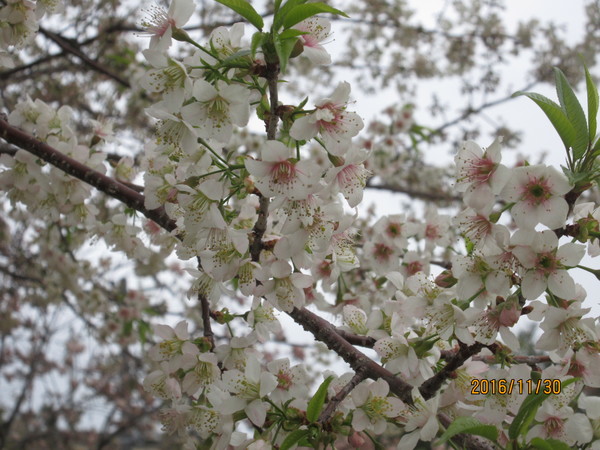
Cerasus cerasoides (sour cherry, "Himarayazakura")
Japanese name: ヒマラヤザクラ
Scientific name: Cerasus cerasoides
[Overview]
A small deciduous tree to tree 3–10 m tall.
In its native range it is found in mountain forests at 1,200–2,400 m above sea level, and some are said to reach 30 m in height.
Young branches are tinged with green and covered with soft hairs.
The leaves are simple and alternate, ovate-lanceolate to lanceolate-oblong, 5–12 cm long and 3–4.5 cm wide.
The upper surface of the leaf is glossy, and both surfaces are hairless.
The leaf margins have double or single serration.
The petiole is 1.2–2 cm long.
The flowers are borne 1–3 in corymbs arising from the leaf axils; they are five-petaled, 3–4 cm across and pale pink, though the flower color varies in depth.
The petals are ovate-round and spread flat.
The style and ovary of the pistil are hairless.
The calyx tube is bell-shaped and tinged with red, and the calyx lobes are pointed triangles about 5 mm long.
The scales are markedly sticky.
The pedicels are 1–1.5 cm long and hairless.
The fruit is about 1–1.5 cm across and ripens to purplish black.
The fruit has a stalk 1–2 cm long.
The surface of the stone has conspicuous wrinkle-like ridges.
[Uses]
In its native region, the fruit and seeds are eaten raw or cooked.
The fruit and leaves are used as dyes.
The wood is hard and fragrant, so it is used as timber.
A substitute for gum tragacanth is obtained from the trunk.
It is said to have a high capacity for absorbing carbon dioxide and nitrogen dioxide, and is attracting attention.
[Cultivation]
It does not adapt easily to the Japanese climate, so cultivation is difficult.
Propagate from seed, cuttings or grafting.
It prefers a place with good sunlight, drainage and water retention.
Its cold tolerance is not very strong, so it is unsuitable for areas that fall below −5 °C.
If it becomes too large in a garden planting, it helps to restrict the space available for root growth with a fabric pot in order to control the size of the tree.
While it is a young tree, protect it from frost by laying straw around the base, for example.
Also, it is better not to cut the branches needlessly if there is no need.
Pests and diseases are numerous, so care is needed.
[Notes]
It stores a lot of nectar in the calyx tube, so birds gather to drink the nectar.
In 1967, when former King Birendra of Nepal (then Crown Prince), who was studying at the University of Tokyo, visited Ito, the Atami Plant Friends Society presented seeds of Sakura and Ume, and in return seeds of Himalaya-zakura were sent.
Plants sown and raised from these at the Atami Municipal Farm in Atami can be seen on the slope below the gate of the prefectural Atami High School.
Details
Japanese: ヒマラヤザクラ
Translated from our Japanese encyclopedia. If anything differs, the Japanese page is correct.