
Plant Encyclopedia

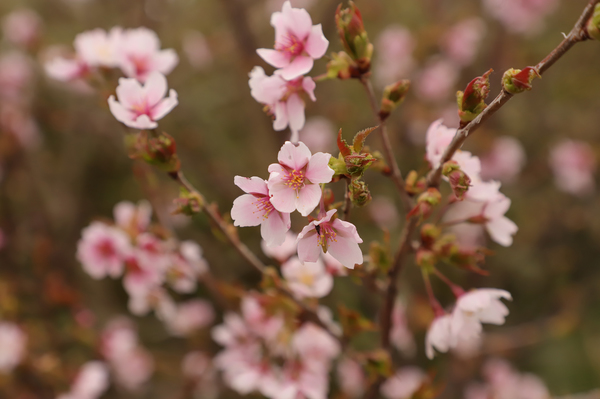
Cerasus nipponica var. nipponica (Japanese alpine cherry, "Takanezakura")
Japanese name: タカネザクラ (高嶺桜)
Scientific name: Cerasus nipponica var. nipponica
[Overview]
A deciduous small to large tree 1–12 m tall, which creeps along the ground and becomes shrubby on wind-exposed sites.
In central Honshu it is found at elevations of 1,500–2,800 m.
The bark is dark gray and glossy, with scattered lenticels.
The first-year branches are hairless.
In shrubby forms the branches often extend horizontally.
The leaves are obovate to obovate-elliptic, 4.2–10.2 cm long and 3.2–6.5 cm wide, with a tail-like pointed tip and a base that is lopsided.
Both surfaces of the leaves are usually hairless.
The leaf margin has sharp double serrations that are incised and end in a gland.
The petiole is 8–12 mm long and hairless, with 2 nectar glands in the upper part.
It flowers at the same time as the leaves unfold.
The flowers are borne 2–3 per umbel in the leaf axils of the previous year's branches, and are pale pink with 5 petals, 1.6–2.3 cm across.
The petals are broadly obovate to broadly elliptic, 1.2–1.3 cm long.
There are about 28–33 stamens, almost as long as the style.
The calyx tube is bell-shaped, 6–7 mm long, and the calyx lobes are 4 mm long with entire margins.
The flower stalk is 2 mm and the pedicels are 1.4–2.2 cm, usually hairless.
The fruit is spherical, 7–8 mm across, ripening blackish purple, and is sweet and sour.
[Cultivation]
Propagate from seed, by cuttings, or by grafting.
It prefers a sunny, well-drained site.
If it becomes too large in a garden planting, it is good to restrict the space for root growth with a fabric pot to control the size of the tree.
While it is a young tree, protect it from frost by laying straw around the base.
Also, it is better not to cut branches needlessly when it is not necessary.
Pests and diseases are numerous, so care is needed.
Details
Japanese: タカネザクラ(高嶺桜)、ミネザクラ(嶺桜、峰桜)
Translated from our Japanese encyclopedia. If anything differs, the Japanese page is correct.