
Plant Encyclopedia

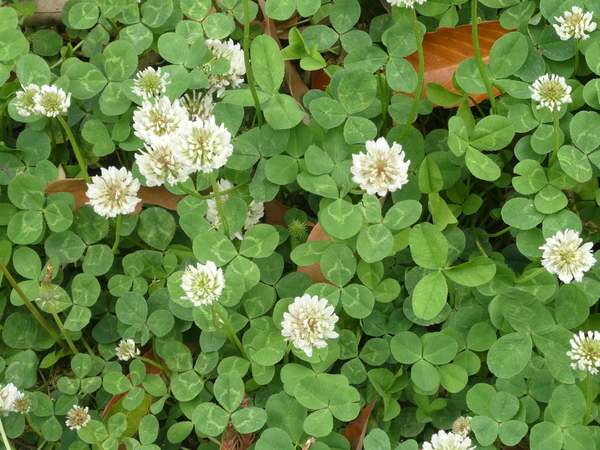
Trifolium repens (white clover, "Shirotsumekusa")
Japanese name: シロツメクサ (白詰草)
Scientific name: Trifolium repens
[Overview]
A perennial very commonly seen in grasslands and similar places.
The stems branch freely and creep along the ground, rooting at the nodes and spreading in a mat, reaching about 1 m in length.
Leaves are alternate and consist of 3 leaflets.
The leaflets are obcordate, 1–3 cm both in length and width, notched at the tip, with a greenish-white V-shaped marking on the upper surface.
The leaf margins have fine teeth.
The leaves have long petioles.
Globose racemes 1.5–3 cm across arise from the leaf axils, densely bearing 30–80 white pea-type flowers about 1 cm long.
The fruit is a legume.
[History]
It arrived in the Edo period (1844–45) as packing material in shipments from the Netherlands, and plants later introduced as forage grass in the early Meiji period have naturalized throughout the country.
[Uses]
The whole plant is used as fodder and green manure, and also medicinally.
The leaves are used in salads.
It is also well known as a honey plant.
[Cultivation]
Propagate from seed or by division.
It prefers a sunny, well-drained, well-ventilated place.
If the environment suits it, it grows well even when left alone once it has taken root.
Rainfall is sufficient for watering.
Because it can synthesize nitrogen through root nodule bacteria, fertilizer is not particularly necessary, and too much fertilizer causes root rot.
There are no particular pests or diseases.
[Notes]
It was named tsumekusa (packing plant) because it was used as packing material when glassware was imported.
Details
Japanese: シロツメクサ(白詰草)、クローバー、オランダゲンゲ
Translated from our Japanese encyclopedia. If anything differs, the Japanese page is correct.