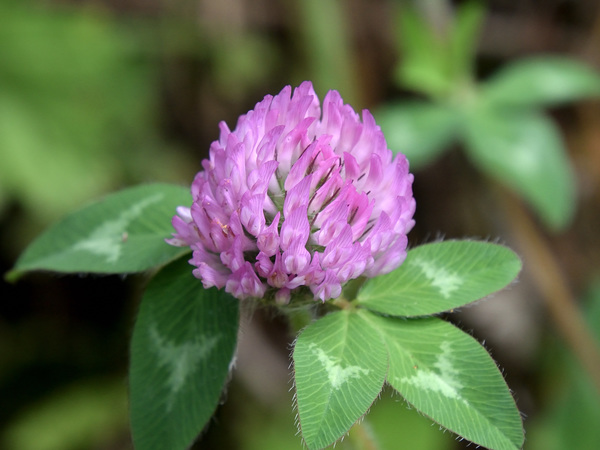
Japanese name: ムラサキツメクサ(紫詰草) Scientific name:Trifolium pratense
[Overview]
A perennial 30–60 cm tall.
The whole plant is covered with soft brown hairs.
Leaves are alternate and consist of 3 leaflets.
The leaflets are obovate, 2–3.5 cm long.
The upper surface of the leaf has a greenish-white V-shaped marking, and the underside is covered with white hairs.
The leaf margins are toothed.
The leaves on the lower part of the stem have long petioles.
Globose racemes arise from the leaf axils at the stem tips, densely bearing pale pink or white pea-type flowers 1.3–1.5 cm long.
The fruit is a legume.
[History]
It was introduced as a forage grass in the early Meiji period.
[Uses]
The whole plant is used as fodder and green manure.
The flowers are used medicinally.
[Cultivation]
Propagate from seed or by division.
It prefers a sunny, well-drained, well-ventilated place.
If the environment suits it, it grows well even when left alone once it has taken root.
Rainfall is sufficient for watering.
Because it can synthesize nitrogen through root nodule bacteria, fertilizer is not particularly necessary, and too much fertilizer causes root rot.
There are no particular pests or diseases.