
Plant Encyclopedia

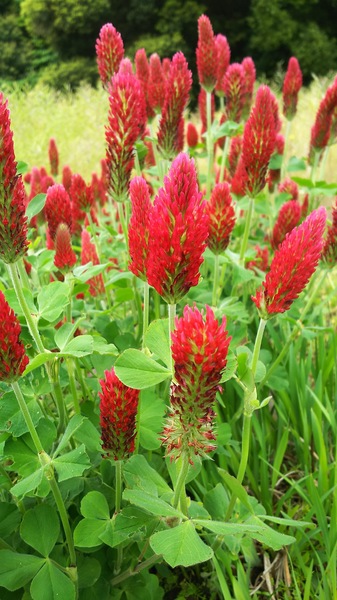
Trifolium incarnatum (crimson clover, "Benibanatsumekusa")
Japanese name: ベニバナツメクサ (紅花詰草)
Scientific name: Trifolium incarnatum
[Overview]
An annual or perennial 20–50 cm tall.
The whole plant is densely covered with soft, pale yellowish-brown hairs.
The stem is unbranched or branched only at the base, grows upright, and can reach about 80 cm in length.
Leaves are alternate and consist of 3 leaflets.
The leaflets are obcordate, 0.8–1.6 cm both in length and width, notched at the tip, and toothed in the upper part.
The leaves have long petioles.
Cylindrical racemes 1.5–5 cm long and 1.5–2 cm across arise from the leaf axils at the stem tips, densely bearing deep red pea-type flowers 1–1.3 cm long.
The inflorescence lengthens as flowering progresses.
The fruit is a legume.
[History]
It was introduced as a forage grass in the early Meiji period.
[Uses]
The whole plant is used as fodder and green manure.
The flowers are used medicinally.
The leaves are also used in herbal tea and salads.
[Cultivation]
Propagate from seed.
It prefers a sunny, well-drained, well-ventilated place.
It prefers a cool environment and may die in the heat and humidity of summer.
If the environment suits it, it grows well even when left alone once it has taken root.
For potted plants, water thoroughly when the soil surface dries; for plants in the ground, rainfall is sufficient.
Because it can synthesize nitrogen through root nodule bacteria, fertilizer is not particularly necessary, and too much fertilizer causes root rot.
There are no particular pests or diseases.
Details
Japanese: ベニバナツメクサ(紅花詰草)、ベニバナウマゴヤシ(紅花馬肥)、クリムソンクローバー、ストロベリーキャンドル、ストロベリートーチ、オランダレンゲ、スカーレットキャンドル
Translated from our Japanese encyclopedia. If anything differs, the Japanese page is correct.