
Plant Encyclopedia

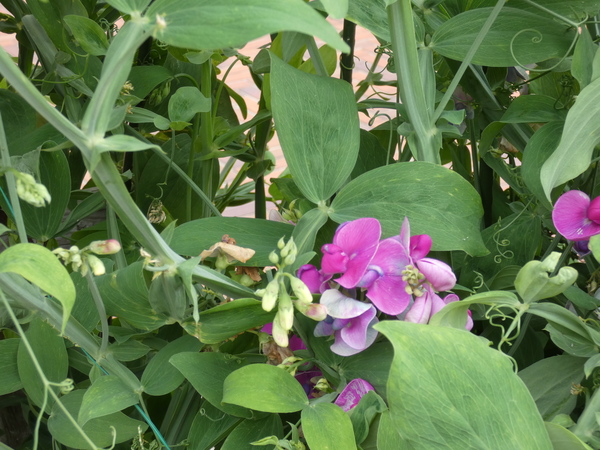
Lathyrus latifolius (perennial pea, "Hirohanorenriso")
Japanese name: ヒロハノレンリソウ (広葉連理草)
Scientific name: Lathyrus latifolius
[Overview]
A climbing perennial that grows to 1.8–3 m.
It has rhizomes.
The stem either creeps along the ground or climbs by twining its branched tendrils around other plants.
The stem is hairless and, like the leaf stalk, has wings.
Leaves are alternate and consist of one pair of leaflets; the leaflets are elliptic to narrowly long-ovate, 4–10 cm long and 0.8–2 cm wide, and bluish green.
At the tip of the leaflets there is a tendril, which is a modified leaf.
The stipules are narrowly ovate, 0.4–1 cm wide.
Racemes arise from the leaf axils and bear 3–11 flowers.
The flowers are white to reddish purple, pea-shaped, 1.5–3 cm long, and not fragrant.
The calyx is 5-lobed with lobes of unequal length; the lowest lobe is longer than the others and is as long as or longer than the calyx tube.
The fruit is a hairless legume 6–13 cm long and 0.7–1 cm wide.
[History]
It is also said to have been introduced to Japan in the early Meiji era as an ornamental, and naturalized plants can be seen in vacant lots and pasture grasslands.
[Cultivation]
Propagate from seed.
Division is also possible, but it dislikes having its roots damaged.
It prefers a sunny site with soil that is well drained, airy and moisture-retentive.
It dislikes acidic soil.
It dislikes growing in the same place year after year, so plant it where no legumes were grown the previous year.
It has a taproot that extends deep, so cultivate the soil thoroughly.
Soak the seeds in water overnight and sow only those that have swollen.
It dislikes transplanting, so whether in the ground or in pots, sow directly where you want to enjoy the flowers and thin the seedlings as they grow.
For seedlings in pots, plant them together with the pot, or transplant them taking care not to damage the roots.
Keep it on the dry side and water after the soil surface has dried.
Apart from base fertilizer, apply liquid fertilizer about once every 2 weeks during the flowering period.
A fertilizer high in nitrogen produces only leafy growth and poor flowering.
Pests and diseases include powdery mildew and aphids.
Details
Japanese: ヒロハノレンリソウ(広葉連理草)、宿根スイートピー
Translated from our Japanese encyclopedia. If anything differs, the Japanese page is correct.