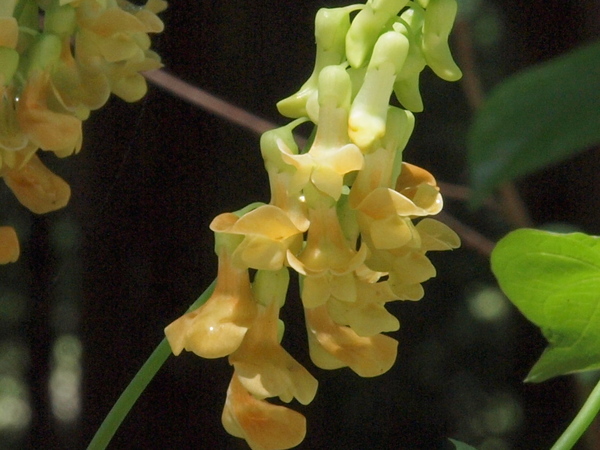
Japanese name: イタチササゲ(鼬_豆) Scientific name:Lathyrus davidii
[Overview]
A perennial 0.6–2 m tall, found in mountain grasslands and in thickets at woodland edges.
The stem is soft and either stands erect or extends by leaning on other plants.
Leaves are alternate and even-pinnately compound with 4–8 leaflets, and the tip of the leaf axis usually becomes a tendril.
Plants without tendrils are called Higenashi-itachi-sasage.
The leaflets are ovate to elliptic, 3–8 cm long and 2–4 cm wide, whitish on the underside, with a conspicuous reticulate vein pattern.
The leaf margin is entire.
The stipules are large, 1.5–5 cm long, variable in shape, and pointed at the tip.
Racemes arise from the leaf axils and bear many pea-shaped flowers facing downward.
The flowers are about 1.5 cm long, yellow at first and later turning yellowish brown.
The calyx lobes are markedly shorter than the calyx tube.
The fruit is a linear legume 8–10 cm long containing a dozen or so seeds.
[Notes]
The Japanese name is said to compare the flower color to the fur color of the weasel (itachi) and the pod to the sasage (cowpea).