
Plant Encyclopedia

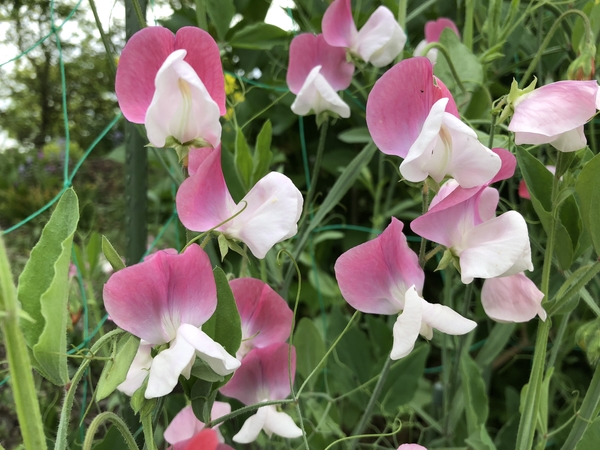
Lathyrus odoratus (sweet pea)
Japanese name: スイートピー
Scientific name: Lathyrus odoratus
[Overview]
A climbing annual that grows to nearly 4 m.
It climbs by twining its branched tendrils around other objects.
The stem is winged.
The leaves are alternate and consist of one pair of leaflets; the leaflets are ovate to ovate-oblong and 6 cm long.
At the tip of the leaflets there is a tendril, which is a modified leaf.
Racemes arise from the leaf axils and bear 1–4 flowers.
The flowers are pea-shaped and fragrant.
In the wild species, the standard petal is deep reddish purple, and the wing petals are pale blue, sometimes with purple veins.
The fruit is a flat, hairy pod 5 cm long.
Garden cultivars have flower colors such as white, pink, purple and red.
[History]
Its first record is said to be in Hortus Catholicus in 1697.
Afterwards it spread, centered on England.
[Cultivation]
Propagate from seed.
There are spring-flowering, summer-flowering, winter-flowering and dwarf types, and at home mainly the spring-flowering types are grown.
It prefers a sunny site with well-drained, well-aerated, moisture-retentive soil.
It dislikes acidic soil.
It dislikes being grown repeatedly in the same place, so plant it where no legumes were grown the previous year.
It has a taproot that grows deep, so cultivate the soil thoroughly.
For spring-flowering types, sow seeds from September to November.
Soak the seeds in water overnight and sow only those that have swollen.
It dislikes transplanting, so sow directly where you want to enjoy the flowers, both in the ground and in pots, and thin the seedlings as they grow.
For seedlings in pots, plant them together with the pot, or repot carefully so as not to damage the roots.
Keep it slightly on the dry side and water after the soil surface has dried.
Except for dwarf types, pinching the vines makes side vines grow from the axils and gives more volume.
In addition to a basal fertilizer, give liquid fertilizer about once every 2 weeks during flowering.
A fertilizer high in nitrogen produces only leaves and poor flowering.
Powdery mildew and aphids can occur.
Details
Japanese: スイートピー、ジャコウレンリソウ(麝香連理草)、スイトピー、カオリエンドウ(香豌豆)、ジャコウエンドウ(麝香豌豆)
Translated from our Japanese encyclopedia. If anything differs, the Japanese page is correct.