
Plant Encyclopedia

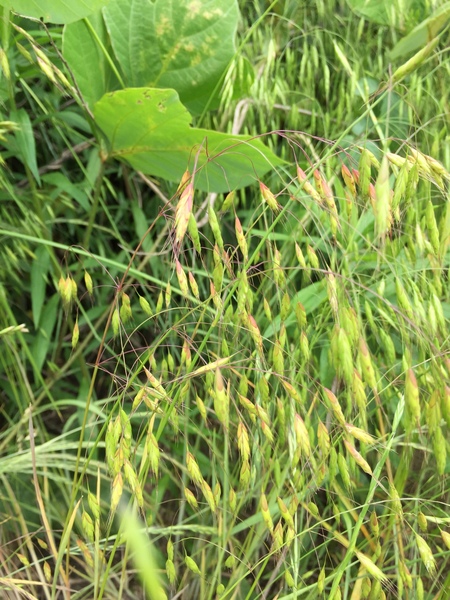
Bromus japonicus (Japanese brome, "Suzumenochahiki")
Japanese name: スズメノチャヒキ (雀の茶挽)
Scientific name: Bromus japonicus
[Overview]
An annual 30–70 cm tall, found in sunny, dry places such as roadsides, wasteland and fields.
The whole plant is covered with soft hairs.
The leaves are linear, 15–30 cm long and 0.3–0.5 cm wide, with many hairs on both surfaces.
The leaf sheath is tubular, with a semicircular ligule about 0.1–0.2 cm long.
A panicle 15–25 cm long is produced, with its tip drooping.
Several branches arise from each node, and each branch bears spikelets sparsely.
The spikelets are oblong, 1.7–2.3 cm long and 0.5–0.7 cm wide, not very flattened, and consist of 6–10 florets.
The first glume is lanceolate, 0.5–0.7 cm long, with 3 veins, and the second glume is 0.7–0.8 cm long with 7–9 veins.
The palea is slightly shorter than the lemma, with long spreading hairs sparsely arranged in a single row on the keel.
The lemma is 0.9–1.1 cm long, oblong to ovate with a rounded back, and is split into 2 at the tip, with an awn emerging from between the lobes.
The awn of the lower spikelets is about 0.3 cm long, but that of the upper ones reaches 1.2 cm and bends outward when ripe.
The margins of the lemma do not roll inward even when ripe, so the rachilla cannot be seen from outside.
[Notes]
The name is said to derive from its resemblance to chahikigusa (another name for Karasumugi), while being smaller and not edible.
Details
Japanese: スズメノチャヒキ(雀の茶挽)
Translated from our Japanese encyclopedia. If anything differs, the Japanese page is correct.