
Plant Encyclopedia

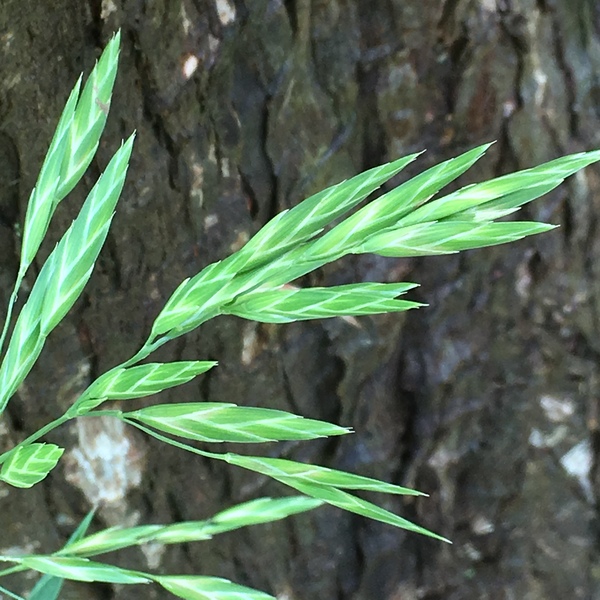
Bromus catharticus (rescuegrass, "Inumugi")
Japanese name: イヌムギ (犬麦)
Scientific name: Bromus catharticus
[Overview]
A short-lived perennial or biennial 40–100 cm tall.
The leaves are linear, 15–30 cm long and 0.4–1 cm wide, sparsely hairy on the underside.
The leaf sheaths are hairy, densely so on the lower ones.
The leaf sheaths have a triangular, membranous ligule.
A panicle 10–25 cm long is produced, bearing spikelets.
The spikelets are 2–3 cm long, consist of 6–9 florets, and are markedly flattened.
The first glume is 0.8–1.3 cm long with 3–5 veins, and the second glume is 1–1.5 cm long with 7–11 veins.
The palea is about 1/3–1/2 the length of the lemma.
The lemma is strongly folded in two, 1.2–1.7 cm long with 9–13 veins, and has a very short awn of 0.1–0.2 cm at the tip.
Some plants bear only cleistogamous flowers, while others open their flowers; in flowering plants, the flowers bloom in April–May, and the anthers are 0.3–0.5 cm long and yellowish brown, hanging down from the florets at flowering.
Cleistogamous flowers are borne until around July, and their anthers are small, 0.5 mm.
[History]
It is presumed to have been introduced as a forage grass, and is a naturalized plant first collected in Tokyo in 1882.
Details
Japanese: イヌムギ(犬麦)
Translated from our Japanese encyclopedia. If anything differs, the Japanese page is correct.