
Plant Encyclopedia

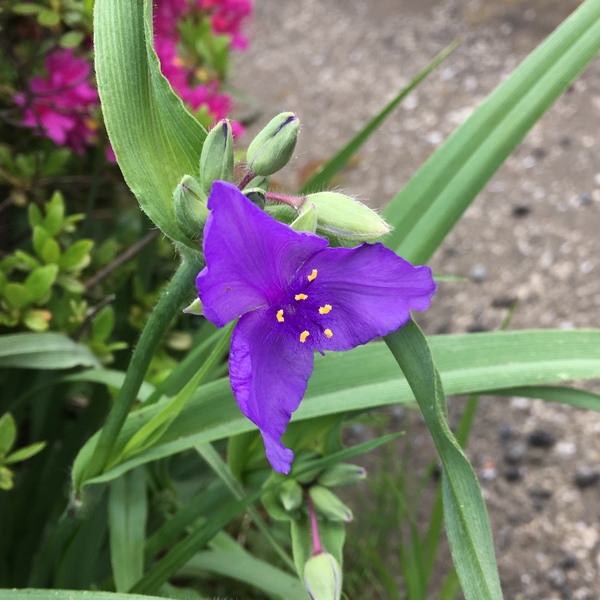
Tradescantia virginiana (Virginia spiderwort, "Omurasakitsuyukusa")
Japanese name: オオムラサキツユクサ (大紫露草)
Scientific name: Tradescantia virginiana
[Overview]
An evergreen perennial 20–60 cm tall.
The stems are erect.
The leaves are simple and alternate, linear-lanceolate, 30–40 cm long, and whitish green.
The leaf base forms a tubular sheath that clasps the stem.
A cyme is produced at the stem tip, and the inflorescence is enclosed by 2 leaf-like bracts.
The flowers are purple, three-petaled, about 2.5–5 cm across, opening in the morning and wilting by noon.
Some flowers are pale pink or white.
There are 6 stamens.
The sepals are green and bear soft hairs.
The fruit is a capsule.
[History]
Introduced in the early Showa era, it can be seen naturalized along roadsides and similar places.
There are cultivars crossed with Murasaki-tsuyukusa and others, and these hybrid cultivars are also often called Omurasaki-tsuyukusa.
It is often confused with Murasaki-tsuyukusa.
[Cultivation]
Propagate from seed or by division.
It also spreads readily from self-sown seed.
It grows well in any soil as long as the site is sunny and well drained.
It adapts to a wide range of conditions, from sun to partial shade and from dry to moist places, and is easy to grow.
For potted plants, to avoid excessive moisture, water thoroughly when the soil dries in spring and autumn, and keep on the dry side in midsummer and winter.
For plants in the ground, no watering is particularly necessary.
Too much fertilizer makes it leggy and prone to falling over, so none is needed for plants in the ground, and for potted plants it is enough to place slow-release fertilizer on the soil once a month in spring and autumn.
Plants that have grown straggly after flowering can be renewed by cutting them back hard.
Southern blight can occur.
Details
Japanese: オオムラサキツユクサ(大紫露草)
Translated from our Japanese encyclopedia. If anything differs, the Japanese page is correct.