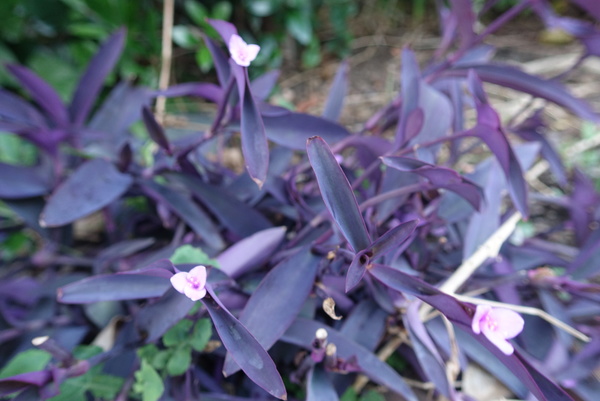
Japanese name: ムラサキオオツユクサ(紫大露草) Scientific name:Tradescantia pallida
[Overview]
An evergreen perennial 40–60 cm tall.
The whole plant is tinged with dark purple.
It has thickened roots.
The stems are erect at first, but as they grow they fall over and creep.
The leaves are simple and alternate, oblong-lanceolate, 13–18 cm long and 2–4 cm wide, fleshy, with pointed tips.
The leaf surface bears soft white hairs.
The leaf base forms a tubular sheath that clasps the stem.
A cyme is produced at the stem tip, and the inflorescence is enclosed by 2 leaf-like bracts.
The flowers are deep pink or white, three-petaled, about 2 cm across, opening in the morning and wilting around noon.
The base of each petal is claw-shaped.
There are 6 stamens, and the filaments are hairy.
The fruit is a capsule.
[History]
Introduced in the mid-1900s, it can be seen escaped along roadsides and similar places in urban areas in warm regions.
[Cultivation]
Propagate by division or cuttings.
It prefers a sunny, well-drained, rather dry location. In shade the leaf color becomes poor, and the plant becomes leggy and weak.
It is relatively cold-hardy and overwinters in the open ground in the Kanto region and south.
Cultivation is easy.