
Plant Encyclopedia

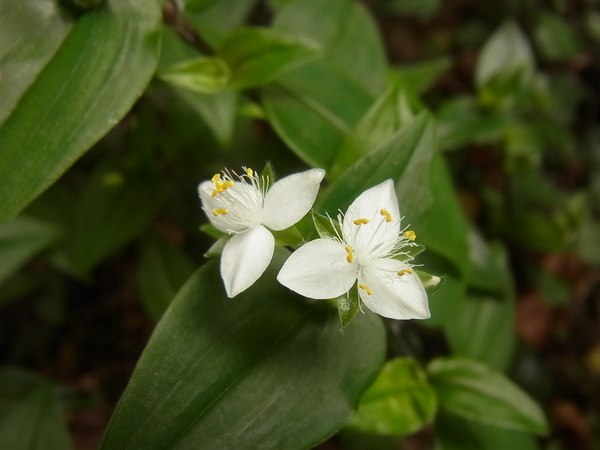
Tradescantia fluminensis ("Nohakatakarakusa")
Japanese name: ノハカタカラクサ (野博多唐草)
Scientific name: Tradescantia fluminensis
[Overview]
An evergreen perennial commonly found in slightly damp shade along roadsides and similar places.
The stems, flower stalks and undersides of the leaves are tinged with purple.
The stem branches well, creeps along the ground, produces roots from the nodes, and extends to about 1 m in length.
The upper part of the stem rises.
The leaves are alternate in two rows, elliptical to lanceolate, 3–6 cm long and 1–3 cm wide, and succulent.
The leaf margins are entire and have fine hairs.
The leaf base forms a tubular sheath that clasps the stem.
The margin of the leaf sheath has white hairs.
A cyme emerges at the stem tip, and the inflorescence is enclosed by 2 bracts.
The flowers are white with 3 petals, about 1.5 cm across.
There are 6 stamens, and the filaments are densely covered with white hairs.
The calyx is green and shorter than the petals, with hairs on the outside.
The fruit is a capsule.
[Cultivation]
Propagate by division or by stem-tip cuttings.
It prefers well-drained soil in sun to partial shade.
It adapts to a wide range of environments and is easy to grow.
To avoid excessive moisture, water thoroughly when the soil has dried in spring and autumn, and keep it on the dry side in midsummer and winter.
From spring to autumn, apply slow-release fertilizer placed on the soil.
Pests and diseases include scale insects and spider mites.
Details
Translated from our Japanese encyclopedia. If anything differs, the Japanese page is correct.