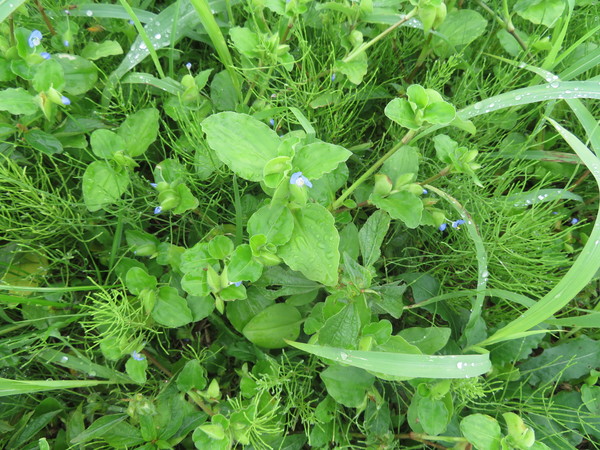
Japanese name: マルバツユクサ(丸葉露草) Scientific name:Commelina benghalensis
[Overview]
A perennial found in sandy ground and fields near the coast.
The stem creeps along the ground at the base, and the upper part rises and branches.
The stem is sparsely hairy.
The leaves are simple and alternate, ovate to broadly ovate, 3–7 cm long and 2–4 cm wide, with a blunt tip and a slightly wavy margin.
The leaf base wraps around the stem like a sheath and has long hairs on the upper edge.
The leaf base wraps around the stem like a sheath and has hairs on the upper edge.
At the stem tip it bears a boat-shaped bract folded in two, and a cyme is borne inside it.
The lower edges of the involucre are fused into a funnel shape and are hairy.
Usually two flowers emerge from the bract and bloom.
Of the 3 petals, 2 are large, 4–5 mm long and blue, and 1 is small.
The sepals are membranous and nearly round.
Of the 6 stamens, only the 2 that protrude long together with the style are fully developed.
In autumn, many closed flowers form underground and set fruit by self-pollination.
The fruit is a capsule that splits in two when ripe, releasing usually 5 seeds of two kinds, large and small.
Flowers derived from closed flowers produce fewer, larger seeds.