
Plant Encyclopedia

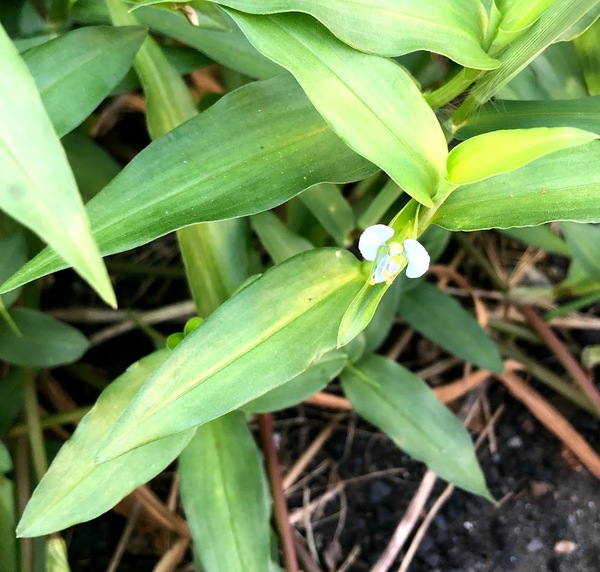
Commelina caroliniana (Carolina dayflower)
Japanese name: カロライナツユクサ
Scientific name: Commelina caroliniana
[Overview]
An annual found on paddy field ridges, beside irrigation channels, and on damp roadsides.
The stems creep along the ground and spread, rooting at the nodes.
The leaves are simple and alternate, lanceolate to ovate-lanceolate, 2.5–10.5 cm long and 0.7–2.4 cm wide, entire and hairless.
The leaf base wraps around the stem like a sheath.
At the tip of the stem is a boat-shaped bract folded in two, containing a cyme.
The bract is about 1.2–3 cm long and 0.5–1 cm wide, is not sickle-shaped, has margins that are not fused, and tapers gradually to a long point; long hairs usually grow along the margin.
The flowers bloom one at a time, emerging outside the bract; there are 3 petals, pale blue and semicircular.
The flower stalk is 0.6–2.3 cm.
The fruit is a capsule divided into 3 chambers and contains 5 seeds.
The seeds are dark brown, 2.4–4.3 mm long and 2–2.3 mm wide, with a smooth surface faintly pitted in a honeycomb pattern and a powdery texture.
A small appendage (elaiosome) is attached to the end of the seed.
[History]
Since 2010 it has been confirmed as naturalized in warm regions, mainly Kyushu, but it closely resembles Shima-tsuyukusa and is confused with it, so its exact naturalization status is unclear.
[Notes]
The scientific name and its name were given after the place of discovery (southeastern United States).
Details
Japanese: カロライナツユクサ
Translated from our Japanese encyclopedia. If anything differs, the Japanese page is correct.