
Plant Encyclopedia

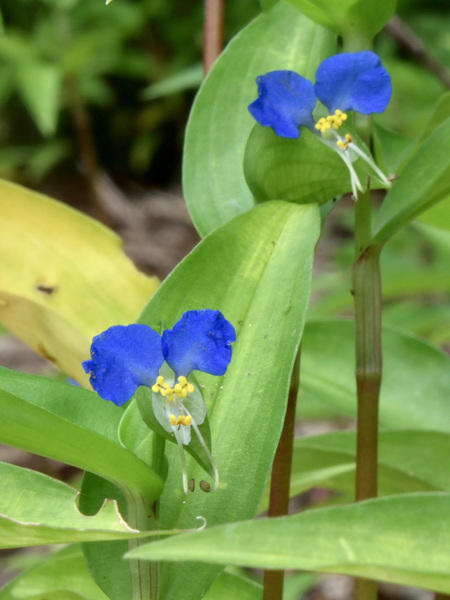
Commelina communis var. communis (Asiatic dayflower, "Tsuyukusa")
Japanese name: ツユクサ (露草)
Scientific name: Commelina communis var. communis
[Overview]
An annual commonly seen along roadsides and in fields.
The stem creeps along the ground at the base, branches, and spreads by producing roots from the nodes.
The upper part of the stem rises to a height of 20–50 cm.
The leaves are simple and alternate, ovate-lanceolate, 5–8 cm long and 1.5–2.5 cm wide, entire and hairless.
The leaf base wraps around the stem like a sheath and has long hairs on the upper edge.
From the leaf axil at the stem tip, opposite the leaf, it bears a boat-shaped bract folded in two, and a cyme is borne inside it.
The flowers emerge from the bract one at a time and bloom, opening in the early morning and wilting in the afternoon.
Of the 3 petals, 2 are large, 10–13 mm long, ovate-round and a vivid, very conspicuous blue, and 1 is small, 4–5 mm long, lanceolate and white.
There are 3 sepals, 3–4 mm long and white; the upper one is lanceolate and the lower two are ovate.
Of the 6 stamens, only the 2 that protrude long together with the style are fully developed.
The fruit is an oblong capsule that splits in two when ripe, releasing 4 seeds.
The seeds are semi-elliptic, 7–8 mm long.
[History]
In the Man'yoshu it is sung of as 'tsukikusa'.
[Uses]
The stems and leaves are used medicinally as a crude drug called osekiso.
The young leaves are also edible.
Details
Japanese: ツユクサ(露草)、ツキクサ(着草、月草)、ボウシバナ(帽子花)、ホタルグサ(蛍草)、アオバナ(青花)、オウセキソウ(鴨跖草)
Translated from our Japanese encyclopedia. If anything differs, the Japanese page is correct.