
Plant Encyclopedia

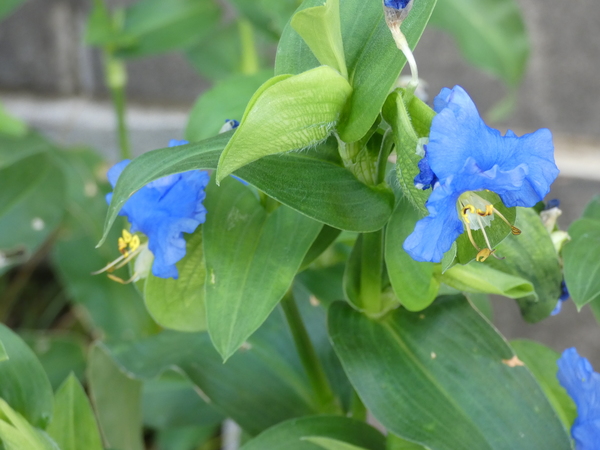
Commelina communis var. hortensis ("Oboshibana")
Japanese name: オオボウシバナ (大帽子花)
Scientific name: Commelina communis var. hortensis
[Overview]
An annual, larger overall than Tsuyukusa.
The stem creeps along the ground at the base and branches, spreading by sending out roots from the nodes.
The upper part of the stem stands up.
The leaves are simple and alternate, ovate-lanceolate, entire and hairless.
The leaf base wraps around the stem like a sheath, and its upper edge has long hairs.
From the leaf axils near the stem tip, opposite the leaves, it bears boat-shaped bracts folded in two, and cymes inside them.
The flowers are large, about 4 cm across, and come out of the bracts one at a time; they open early in the morning and wither in the afternoon.
Of the 3 petals, 2 are large, ovate-round, and a vivid, conspicuous blue; 1 is small, lanceolate and white.
There are 3 white sepals; the upper one is lanceolate and the lower 2 are ovate.
Of the 6 stamens, only the 2 that protrude long together with the style are fertile.
The fruit is an oblong capsule that splits in two when ripe, releasing 4 seeds.
The seeds are semi-elliptical, 7–8 mm long.
[Uses]
Washi (Japanese paper) soaked with the blue juice squeezed from the flowers is called aobanagami ("blue-flower paper").
A brush moistened and touched to this paper is used to draw underdrawings for yuzen dyeing and shibori dyeing in its blue color.
This pigment is weak to heat, so it disappears during the dyeing process.
[Notes]
It has been cultivated in the Konan region, centered on Kusatsu, Shiga, since the mid-Edo period, and is a specialty product of the Omi region.
It is designated as the city flower of Kusatsu, Shiga.
Details
Translated from our Japanese encyclopedia. If anything differs, the Japanese page is correct.