
Plant Encyclopedia

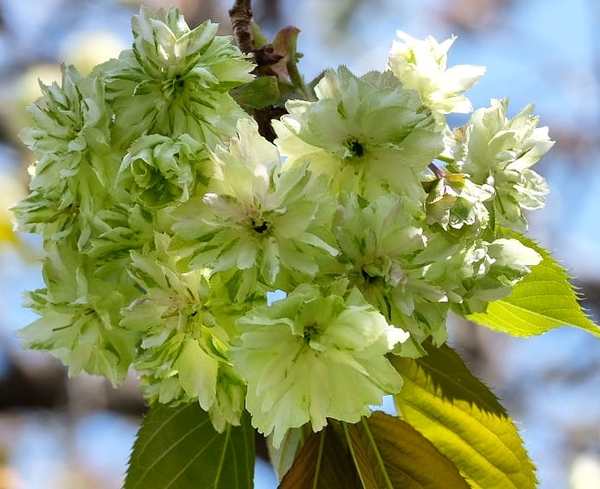
Cerasus serrulata ‘Gioiko’
Japanese name: サトザクラ‘御衣黄’
Scientific name: Cerasus serrulata ‘Gioiko’
[Overview]
A cultivar of Sato-zakura.
A deciduous tree.
The young leaves are brown with a slightly yellowish-green tinge.
The leaves are simple and alternate, elliptic to obovate or oblong-oblanceolate, about 6–14 cm long and 4–6 cm wide, with a tail-like pointed tip.
The leaf margins have a mixture of single and double serrations, and the tips of the teeth extend into fine thread-like points.
The undersides of the leaves are tinged with white.
The flowers open after the leaves have unfolded.
The flowers are borne 2–5 at a time in umbel-like to corymb-like inflorescences arising from the leaf axils.
The flowers vary in size, 2–4.5 cm across, and are pale green with dark green streaks; there are about 13 petals.
The outer petals curl outward at the tip and have fine notches.
As the flowers near the end of blooming, red lines appear along the midrib from the base.
There is 1 pistil, which protrudes far beyond the stamens; there are about 30 stamens, which are very short.
The calyx lobes are usually entire.
The flower stalk is 1.5–3.5 cm long, and the pedicel is 2.5–3.5 cm long.
[History]
A cultivar that was grown on the Arakawa embankment in Tokyo.
[Cultivation]
Propagate by cuttings or grafting.
It prefers a sunny, well-drained site.
If it grows into a large tree in a garden and becomes a problem, it is good to limit the space available to the roots with a fabric pot in order to control the size of the tree.
While it is a young tree, protect it from frost by spreading straw around the base of the plant.
Also, it is better not to cut the branches needlessly when it is not necessary.
It is prone to many pests and diseases, so care is needed.
[Notes]
Because it bears green flowers, which are rare, it is widely planted.
Details
Translated from our Japanese encyclopedia. If anything differs, the Japanese page is correct.