
Plant Encyclopedia

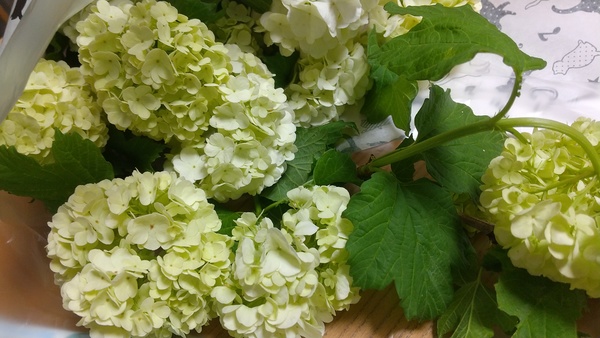
Viburnum opulus var. opulus (European cranberrybush, "Seiyokanboku")
Japanese name: セイヨウカンボク (西洋肝木)
Scientific name: Viburnum opulus var. opulus
[Overview]
A deciduous shrub about 3–4.5 m tall.
The bark is thin with few fissures.
Leaves are opposite, broadly ovate, 5–10 cm long and wide, and 3-lobed to about the middle.
On the upper surface three veins are conspicuous, and the veins are sunken, giving the leaf a wrinkled look; the margin has coarse teeth.
There are disc-shaped glands near the tip of the leaf stalk and stipules near the base.
Flat corymbs 6–10 cm across are produced at the branch tips.
The flowers are white, about 0.5 cm across, with yellowish white anthers.
Around the inflorescence are white decorative flowers about 2 cm across, with a 5-lobed corolla.
The fruit is spherical, 0.7–1 cm across, ripening red and hanging down.
[Uses]
The bark is used medicinally.
[Cultivation]
Propagate from seed or by cuttings.
When growing from seed, collect ripe fruits, wash off the pulp thoroughly, and then sow.
It grows well in any soil type as long as the site is sunny, well drained and rich in humus.
For potted plants, water thoroughly when the soil surface dries; for plants in the ground, rainfall is sufficient unless summer brings a long spell of sunny weather and the soil becomes severely dry.
Apply fertilizer in winter, and after flowering apply a slow-release chemical fertilizer with equal amounts of the three main components as a thank-you fertilizer.
It is not pruned, so that its natural shape can be enjoyed, but to keep it compact, cut slightly above a bud as soon as possible after flowering.
Watch out for powdery mildew and scale insects, which occur easily when ventilation is poor.
Details
Japanese: セイヨウカンボク(西洋肝木)、ヨウシュカンボク(洋種肝木)
Translated from our Japanese encyclopedia. If anything differs, the Japanese page is correct.