
Plant Encyclopedia

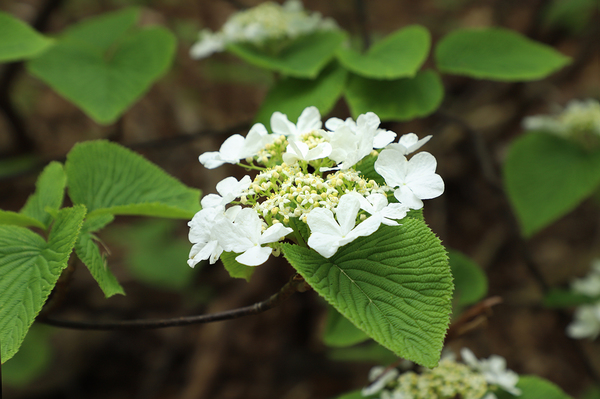
Viburnum furcatum (forked viburnum, "Okamenoki")
Japanese name: オオカメノキ (大亀木)
Scientific name: Viburnum furcatum
[Overview]
A small deciduous tree about 6 m tall, growing in beech forests and subalpine coniferous forests.
Young branches have stellate hairs.
The leaves are simple and opposite, broadly ovate to round, 6–20 cm in both length and width.
On the upper surface of the leaf the veins are sunken, making it wrinkled; there are 7–10 pairs of lateral veins that run almost straight, and the margin has double serrations.
Stellate hairs grow on the veins of the upper surface and on the underside of the leaf.
The leaf stalk is long at 1.5–4 cm, and there are no stipules.
Flat corymbs 6–13 cm across are produced at the branch tips, and there is a pair of leaves at the base of the inflorescence.
The flowers are white, 0.6–0.8 cm across, and faintly fragrant.
Around the inflorescence there are white sterile flowers 2–3.5 cm across.
The corolla is 5-lobed.
The fruit is elliptic, 0.7–1 cm long, first red and later ripening to black.
[Cultivation]
Propagate from seed or by cuttings.
For seed, collect ripe fruit, wash the pulp off thoroughly, and then sow.
It grows well regardless of soil type as long as the site is sunny to partially shaded, well drained, and rich in humus.
For potted plants, water thoroughly when the soil surface dries; for plants in the ground, rainfall is sufficient unless summer brings a long spell of sunny weather and the soil becomes severely dry.
Apply fertilizer in winter, and also, after flowering, apply a slow-release chemical fertilizer with equal amounts of the 3 components as a thank-you fertilizer.
Powdery mildew and scale insects occur easily when ventilation is poor, so care is needed.
Details
Japanese: オオカメノキ(大亀木)、ムシカリ(虫狩)
Translated from our Japanese encyclopedia. If anything differs, the Japanese page is correct.