
Plant Encyclopedia

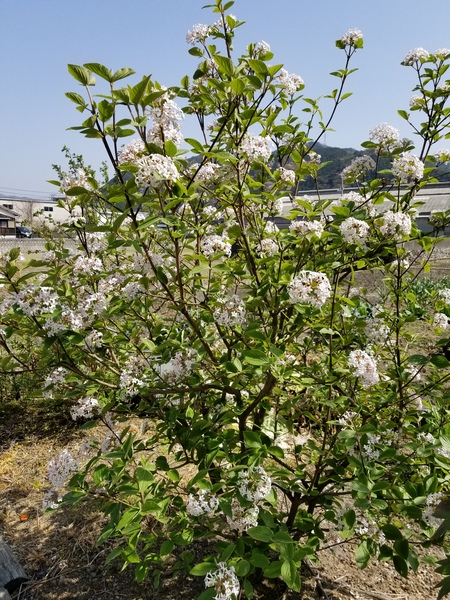
Viburnum carlesii var. carlesii ("Ochojigamazumi")
Japanese name: オオチョウジガマズミ (大丁字莢蒾)
Scientific name: Viburnum carlesii var. carlesii
[Overview]
A deciduous shrub 1–3 m tall, found on cliffs near the coast and at sunny forest edges in the mountains.
Young branches bear stellate hairs.
The leaves are simple and opposite, broadly ovate to ovate.
The upper surface of the leaf is hairy, and the veins on the underside bear stellate hairs.
There are 4–6 pairs of lateral veins, which are slightly curved, and the margin is serrated.
There is a short leaf stalk.
Cymes 3–5 cm across at the branch tips have stalks bearing stellate hairs.
The flowers are 1–1.6 cm across and white, pink-tinged on the outside, and reddish purple in bud.
The corolla is 5-lobed.
The calyx lobes often have cilia.
The flowers are fragrant.
The fruit is a flat oval 0.7–1 cm long and ripens black.
[Cultivation]
Propagate from seed or by cuttings.
When growing from seed, collect ripe fruit, wash off the pulp thoroughly, and then sow.
It prefers sunny, well-drained, fertile soil.
For potted plants, water thoroughly when the soil surface dries; for plants in the ground, rainfall is sufficient unless summer brings a long spell of sunny weather and the soil becomes severely dry.
Apply fertilizer in winter, and after flowering apply a slow-release chemical fertilizer with equal amounts of the three components as a thank-you fertilizer.
It is not pruned, so that its natural form can be enjoyed, but when a compact shape is wanted, cut unneeded branches at the base as soon as possible after flowering.
Poor ventilation makes powdery mildew and scale insects likely to occur, so care is needed.
Details
Translated from our Japanese encyclopedia. If anything differs, the Japanese page is correct.