
Plant Encyclopedia

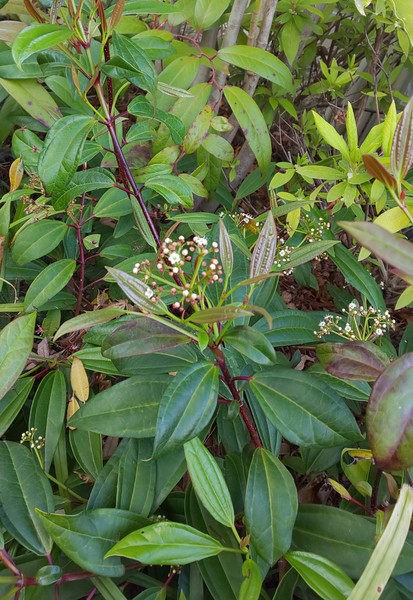
Viburnum davidii (David viburnum)
Japanese name: ビブルヌム ダビディー
Scientific name: Viburnum davidii
[Overview]
An evergreen shrub about 1 m tall.
It branches well and forms a rounded shape.
Young branches are tinged with purple.
The leaves are simple and opposite, elliptic, 6–14 cm long and 4–7 cm wide, and thick.
The upper surface is dark green and glossy, with three conspicuous veins.
The leaf margins are entire.
The petioles are tinged with purple.
The leaves take on a reddish black color in cold weather.
Corymbs 4–6 cm across are produced at the branch tips.
The flowers are tinged with pink in bud and turn white when open; the corolla is 5-lobed.
Depending on the plant, female or male flowers tend to predominate.
The fruit is elliptic and ripens to a blackish indigo blue, and the stalk of the fruit cluster is usually crimson.
[Cultivation]
Propagate from seed or by cuttings.
When growing from seed, collect ripe fruits, wash off the pulp thoroughly, and then sow.
It grows well in any soil as long as the site is sunny or partially shaded, well drained and rich in humus.
Strong direct sunlight in midsummer can cause leaf scorch.
For potted plants, water thoroughly when the soil surface dries; for plants in the ground, rainfall is sufficient unless summer brings a long spell of sunny weather and the soil becomes severely dry.
Apply fertilizer in winter, and also after flowering as a thank-you fertilizer, using a slow-release chemical fertilizer with equal amounts of the three components.
It is not pruned, so that its natural shape can be enjoyed, but to keep it compact, cut just above a bud as early as possible after flowering.
Poor ventilation makes powdery mildew and scale insects likely to occur, so take care.
Details
Japanese: ビブルヌム ダビディー
Translated from our Japanese encyclopedia. If anything differs, the Japanese page is correct.