
Plant Encyclopedia

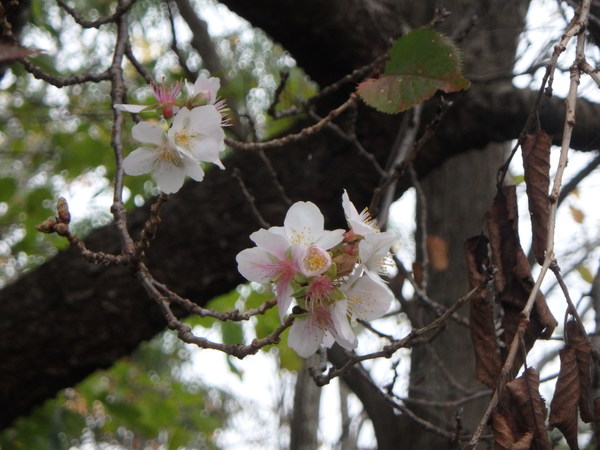
Cerasus ×parvifolia ("Fuyuzakura")
Japanese name: フユザクラ (冬桜)
Scientific name: Cerasus ×parvifolia
[Overview]
A small deciduous tree presumed to be a hybrid of Yamazakura and Mamezakura, or of Satozakura and Mamezakura.
The bark is purplish brown and glossy, and the young branches are hairless.
The young shoots are yellowish green tinged with reddish purple.
The leaves are ovate to obovate, 3–8 cm long and 1.5–4.5 cm wide, with a slightly tail-like pointed tip.
The leaf margins are doubly serrate mixed with some simple serrations, and the tips of the teeth are slightly awn-like.
The upper surface of the leaf is hairy and glossy, and the underside is almost hairless or hairy only on the veins.
The nectaries are on the upper part of the petiole or at the base of the leaf blade.
It is a twice-flowering tree: the flowers begin to open around October, bloom most abundantly from late November to early December, continue to open sporadically through the winter, and bloom abundantly again in spring.
Young leaves do not appear during the winter flowering period, and unfold somewhat when the spring flowers open.
The flowers are borne 1–4 in corymbs from the leaf axils; they are five-petaled, at first slightly tinged with red but later white, and 2.9–3.6 cm across.
The petals are broadly ovate, about 1.5 cm long, and in the spring flowers the tips are notched.
The calyx tube is cylindrical and tinged with reddish purple, and the calyx lobes are oblong, entire or slightly serrated; both are hairless.
In winter flowers there is almost no flower stalk and the pedicel is 0.3–0.4 cm long; in spring flowers the flower stalk is 0.5–1 cm long and the pedicel 1–2 cm long, slightly hairy.
The fruit ripens black and is sweet.
[Cultivation]
Propagate by cuttings or grafting.
It prefers a sunny, well-drained place.
If it is a problem for the tree to grow large in a garden, restrict the space in which the roots can spread with a fabric pot to control its size.
While it is a young tree, protect it from frost by, for example, laying straw around the base.
Also, it is better not to cut branches needlessly if there is no need.
It suffers from many pests and diseases, so care is needed.
Details
Translated from our Japanese encyclopedia. If anything differs, the Japanese page is correct.