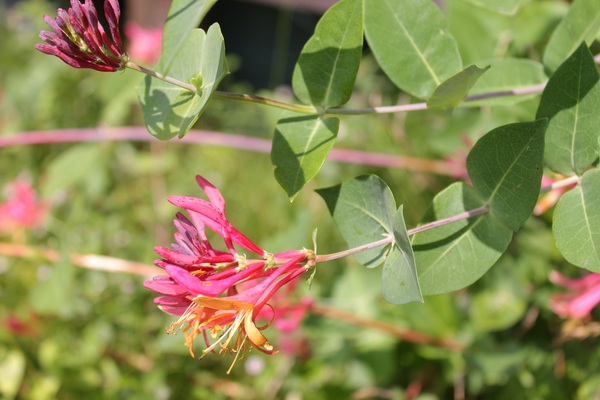
Japanese name: ロニケラ ヘクロッティー Scientific name:Lonicera ×heckrottii
[Overview]
A semi-evergreen climbing shrub.
The vines branch freely and grow to about 3–4.5 m, becoming woody at the base.
Young branches are often tinged with red.
The leaves are simple and opposite, elliptic, about 5 cm long, entire, bluish green, and almost stalkless.
The one or two pairs of leaves just below the flowers are joined at the base, so the stem appears to pass through them.
The flowers are borne in whorls at the stem tips; they are tubular, 5–6 cm long, and 5-lobed at the tip.
The corolla is purplish red on the outside and orange-yellow on the inside.
The flowers are fragrant.
The fruit is a spherical berry that ripens red.
[History]
It is thought to be a cross between Lonicera americana and Tsukinuki-nindo.
[Cultivation]
Propagate by cuttings.
It prefers fertile soil that is sunny and well drained.
Rainfall is sufficient unless summer brings a long spell of sunny weather and the soil becomes severely dry.
In early summer, apply slow-release chemical fertilizer placed on the soil.
The vines do not twine much on their own, so tie them with string to guide them.
It can also be pruned and trained into a shrub 1–2 m tall.
There are no particular pests or diseases.